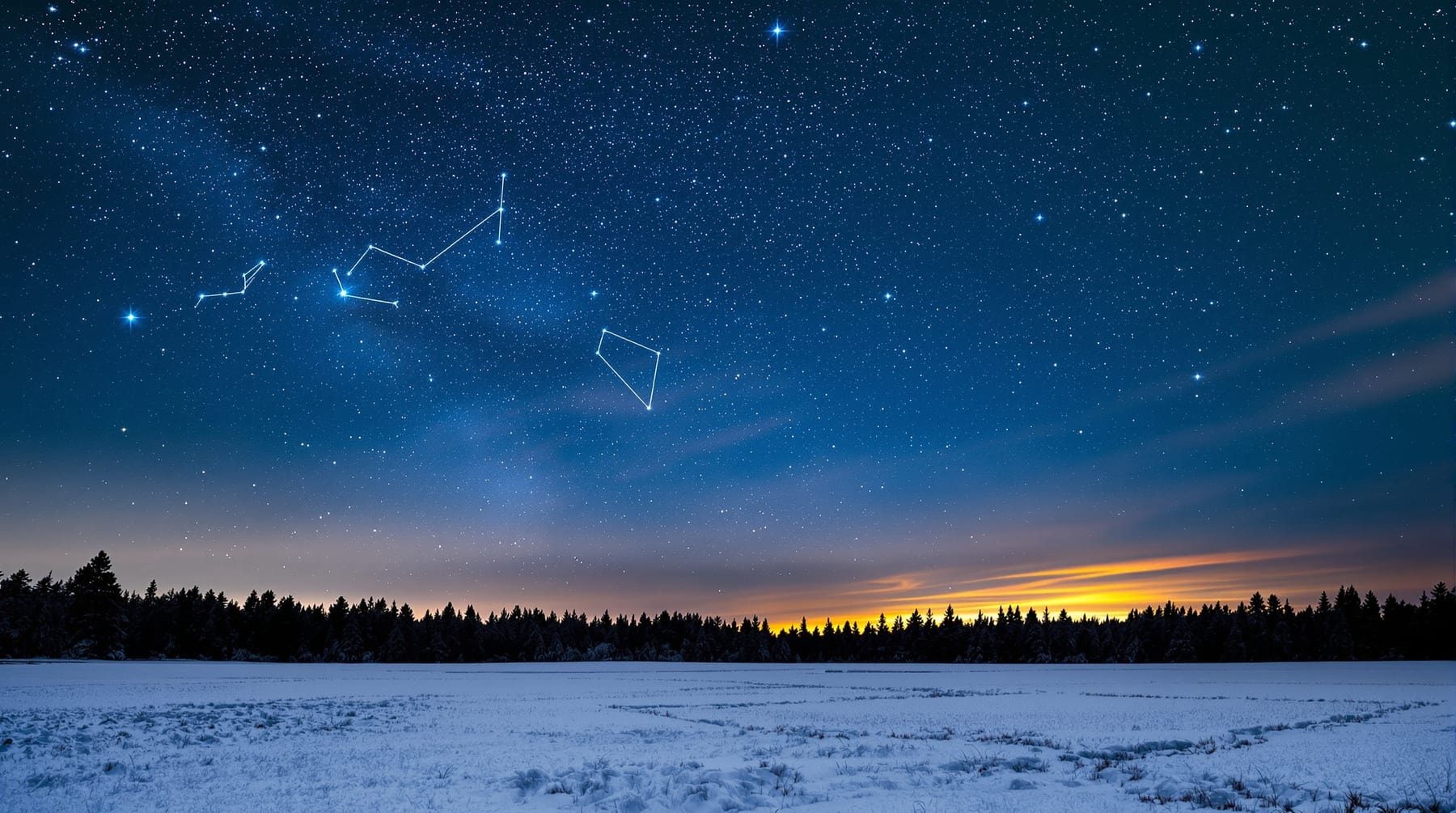
The Fraser Valley sits at almost exactly 49 degrees of latitude, and that number determines what you can see far more than any equipment decision does. This page works through the year as it appears from here — what is permanently on show, what comes and goes, what is worth waiting up for, and what is simply out of reach from this part of the world.
The geometry, once, properly
Two numbers explain almost everything about a latitude's sky.
The first is the altitude of the celestial pole, which always equals your latitude. From the valley the north celestial pole sits 49 degrees above the northern horizon — close to halfway up. Polaris marks it to within about two-thirds of a degree.
The second follows from it: anything within 49 degrees of the pole, meaning any object with a declination north of about +41 degrees, never sets. It circles the pole all night and is available every single clear night of the year. Symmetrically, anything south of declination -41 degrees never rises, and is permanently invisible from here.
For anything in between, the height it reaches when it crosses the meridian due south is simply 90 degrees, minus your latitude, plus its declination. An object at declination -29 degrees — the galactic centre, roughly — culminates at 12 degrees. An object at declination +20 degrees culminates at 61 degrees, comfortably high.
Always available: the circumpolar sky
The circumpolar region is the valley observer's permanent library, and it contains more than its reputation suggests.
- Ursa Major, including the Big Dipper asterism, which never sets and functions as the sky's most reliable signpost. Mizar and Alcor in the handle are a naked-eye pair; Mizar itself splits in a small telescope. The pair of galaxies M81 and M82 sit in the same low-power field and are within reach of binoculars from a dark site.
- Cassiopeia, the W, on the opposite side of the pole. It rides high in autumn and low in spring, and it sits directly in the Milky Way, so its whole area repays a slow binocular sweep.
- Cepheus, less obvious but home to Delta Cephei, the prototype variable star whose period-luminosity relationship became the foundation of the extragalactic distance scale, and to the deep-red Garnet Star.
- Draco, winding between the two bears, containing the Cat's Eye Nebula.
- Perseus, mostly circumpolar from here, and containing the Double Cluster — two adjacent open clusters that are among the finest binocular objects in the entire sky and are essentially always accessible from this latitude.
Spring: galaxy season
From roughly March to May the evening sky looks away from the plane of our own galaxy, out into intergalactic space. There is very little gas and dust in the way, and what you get instead of nebulae is galaxies, in quantity.
The Virgo cluster, straddling Virgo and Coma Berenices, culminates high enough from here to be genuinely workable, and a moderate telescope from a dark site will show a dozen or more member galaxies in a single evening's sweep. Leo carries its own bright trio. The Whirlpool Galaxy in Canes Venatici shows spiral structure in larger amateur instruments under good conditions.
Spring is also the season for the Big Dipper standing on its handle high overhead, and for Arcturus — follow the curve of the Dipper's handle and "arc to Arcturus", then "speed on to Spica". Spring nights on this coast are frequently transparent after a frontal passage, and the season is short: by early June there is no astronomical darkness left.
Summer: no darkness, then the best of the year
June is a write-off for deep-sky work and the best month for noctilucent clouds. From roughly late May to mid-July the Sun stays too close to the horizon at midnight for the sky ever to become fully dark.
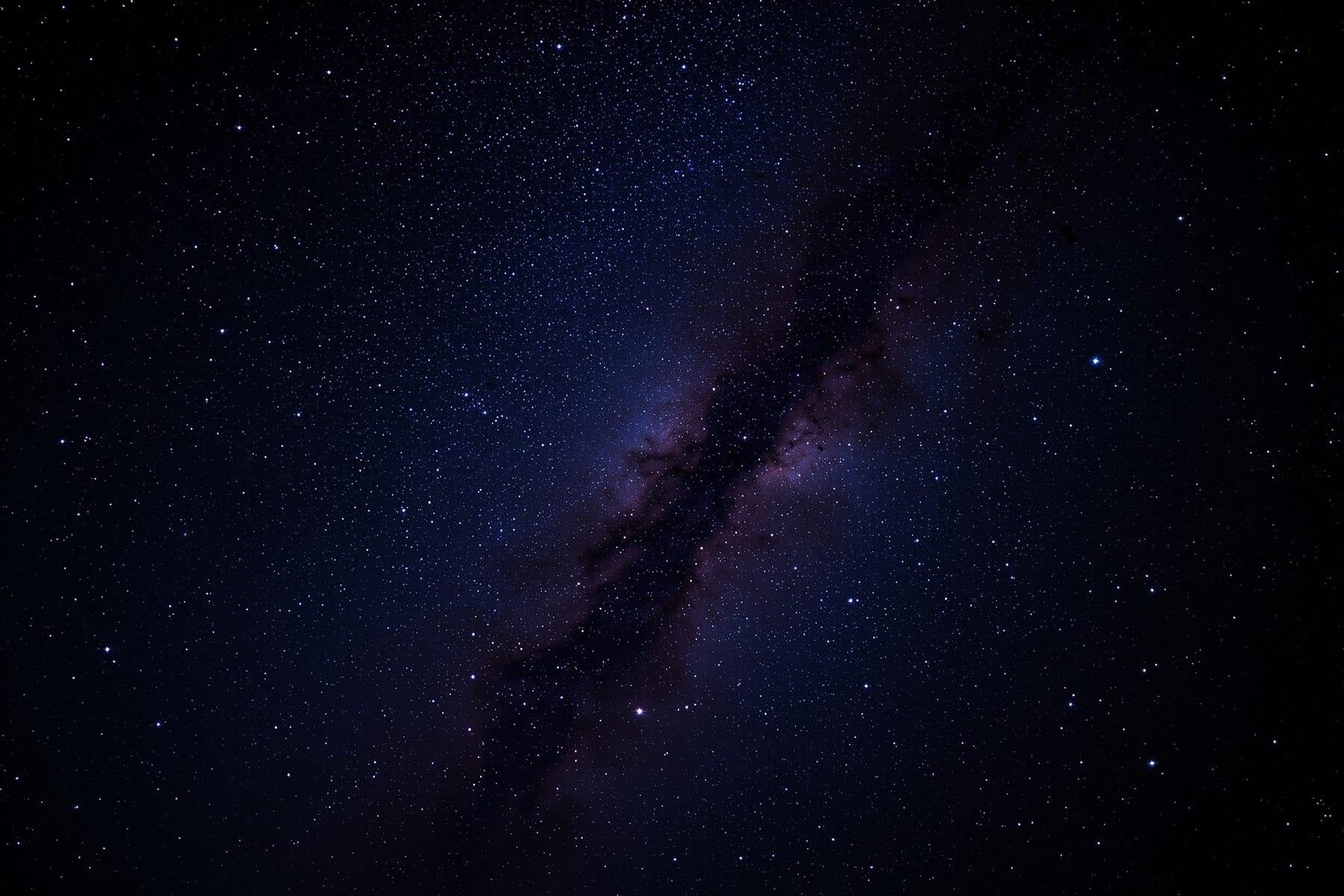
From late July the nights return quickly, and August and early September are the valley's showcase weeks. The Summer Triangle — Vega, Deneb and Altair — sits near the zenith, and the Milky Way runs straight through it, up from Sagittarius in the south, through Aquila and Scutum, into Cygnus overhead and on to Cassiopeia in the north-east. That overhead stretch is the part to concentrate on from here, because it is being viewed through minimum atmosphere. The Great Rift, the dark dust lane splitting the band lengthwise, is obvious to the naked eye from a dark valley site.
Specific targets worth the effort: the Ring Nebula in Lyra, small but unmistakable; Albireo in Cygnus, a gold-and-blue double that is arguably the prettiest thing in a small telescope; the Coathanger asterism in Vulpecula, a binocular object; the globular cluster M13 in Hercules, which resolves into individual stars in a medium telescope; and the Wild Duck Cluster M11 in Scutum, one of the densest open clusters in the sky.
The Sagittarius region — the Lagoon and Trifid nebulae, the Sagittarius Star Cloud, a dense field of globular clusters — is all technically visible but all badly compromised at this latitude, culminating around twelve degrees up and directly over the southern horizon glow. See it, by all means, but understand that you are seeing a fraction of what an observer three thousand kilometres south sees.
The Perseid meteor shower peaks around the twelfth and thirteenth of August each year, with the radiant in Perseus and debris supplied by comet 109P/Swift-Tuttle. It is the best-observed shower of the year in the northern hemisphere largely because it happens in warm weather. Rates depend heavily on moonlight in a given year.
Autumn: the transparent season
September and October are, on balance, the best observing months on this coast. The air behind an autumn front is cold, dry and stable; the nights are long; and the temperature has not yet reached the point where standing outside for four hours requires serious commitment.
Overhead sit the Great Square of Pegasus and Andromeda. The Andromeda Galaxy is an easy naked-eye object from a dark valley site — a distinctly elongated smudge — and in binoculars it is large and obviously structured. It is the most distant thing most people ever see without instruments, at about two and a half million light years. Nearby, the Triangulum Galaxy is a harder naked-eye target and a good test of both sky and observer.
Autumn also brings the Double Cluster to a high position, Cassiopeia to the zenith, and the first return of the winter constellations in the small hours. The Orionid shower peaks around the twenty-first of October, from debris left by Halley's Comet.
Winter: the brightest sky and the coldest nights
Winter has the highest concentration of bright stars of any season, and from 49 degrees north it also has sixteen hours of darkness to work with.
Orion dominates, and the Orion Nebula below the belt is the finest emission nebula visible from the northern hemisphere — a genuinely three-dimensional-looking object in a moderate telescope, with the four stars of the Trapezium embedded in it. Around Orion: Taurus with the Pleiades (better in binoculars than in most telescopes, because they need the field of view) and the Hyades; Auriga with three fine open clusters; Gemini; Canis Major with Sirius, the brightest star in the sky, which from this latitude culminates low enough to scintillate spectacularly through the thick air.
The Geminid meteor shower around the thirteenth and fourteenth of December is arguably the year's best — rich, reliable, with slow bright meteors — and is supplied not by a comet but by the rock-comet asteroid 3200 Phaethon. The Quadrantids in early January have a very sharp peak lasting only a few hours, which makes them a gamble, but a well-timed one can be excellent.
Winter's limitation on this coast is simply the weather: long stretches of the season are overcast, and the good nights are often the coldest. The trade is worth making. A clear, cold, breezy January night in the valley delivers the year's best transparency, and the sky it reveals is the richest of the twelve months.
Keeping track
Planet positions, conjunctions, eclipses and the phase of the Moon all shift year to year, and no static page can carry them honestly. NASA's monthly skywatching summary and the ephemeris tools at in-the-sky.org and Heavens-Above handle that far better, and a planetarium program such as Stellarium will show you the sky from your own coordinates at any date and time. For meteor shower predictions specifically, the International Meteor Organization publishes an annual calendar with expected peak times and rates.
Whatever the season, the Moon governs everything. Full Moon washes out all faint objects and is a bad night for deep-sky work and a good one for lunar and planetary observing. Work the week either side of new Moon for anything faint, and use the bright half of the month for the Moon itself, the planets and double stars.