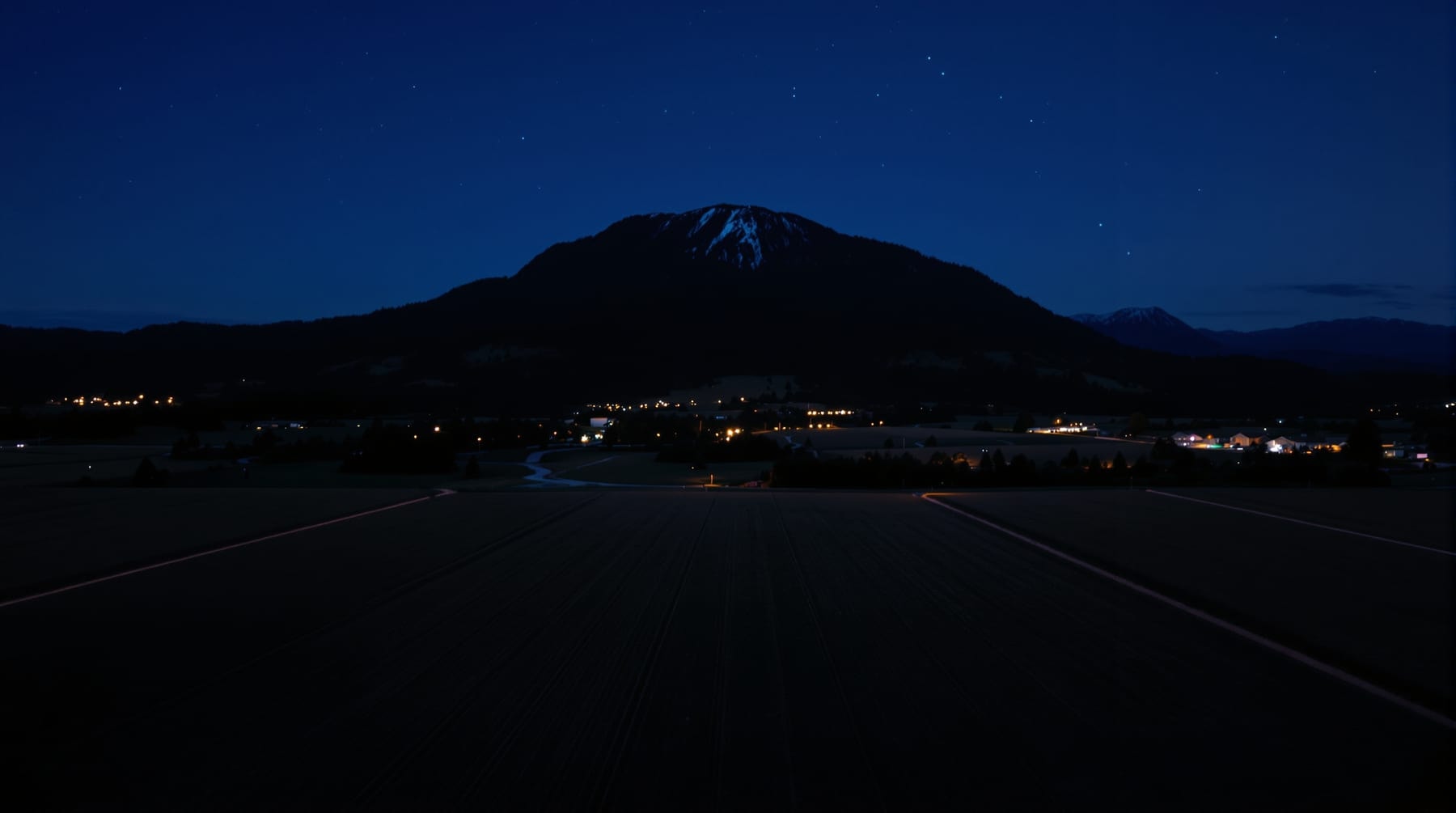
There are not many places where light pollution has been measurably reversed. The general direction of travel, everywhere in the industrialised world, is one way: more fixtures, more lumens, brighter horizons every decade. The Fraser Valley contains a small, well-documented and genuinely unusual counter-example, and it is worth setting out clearly, because it is a matter of public record rather than folklore and because it shows what the practical levers actually are.
This page is an account of a sequence of municipal, utility and landowner decisions. It is not a history of any organisation, and this guide represents none.
The precedent that started it
In 1999 the Ontario government designated the Torrance Barrens, a roughly 1,990-hectare tract of exposed Crown land in the Muskoka district, as a protected area in which the darkness of the night sky was itself a conservation objective. It attracted national newspaper coverage at the time, largely because the idea was novel: land had been protected for its water, its wildlife and its scenery, but not before for the absence of light above it.
That coverage travelled. In British Columbia it landed among people who had spent years watching the western horizon get brighter and had assumed nothing could be done about it, and it reframed the problem. If a provincial land manager in Ontario could write the night sky into a management plan, the argument was no longer whether such a thing was possible — only whether a suitable site existed locally and whether the relevant authorities could be persuaded. A fuller account of the Canadian designation framework is on the dark-sky preserves in Canada page.
Why McDonald Park was the right site
The site chosen was McDonald Park, a City of Abbotsford municipal park off No. 3 Road, tucked against the western flank of Sumas Mountain roughly midway between Abbotsford and Chilliwack. It was not chosen because it was the darkest place in the region — it plainly is not, and a two-hour drive into the interior will beat it comfortably. It was chosen because of a specific and unusual combination of properties.
- Terrain screening on three sides. Sumas Mountain blocks the Chilliwack light dome to the east almost completely, takes a substantial bite out of Abbotsford's to the west, and cuts off Mission's to the north. Terrain is the only perfectly reliable light shield.
- A low, open, dark exposure through the south. The remaining arc looks out over farmland, which is the direction everything culminates from and the direction with the fewest permanent light sources.
- Genuine accessibility. Ten to twelve minutes from a city, on paved road, with flat ground and existing facilities. A dark site that takes three hours to reach gets used four times a year; one that takes fifteen minutes gets used four times a month, and use is what builds a constituency.
- A single, identifiable land manager. One municipality owned the park and controlled or influenced most of the lighting that affected it. That made the problem tractable in a way it would not have been across three jurisdictions.
What was actually changed
The interesting part of the story is not the designation but the engineering, because the lighting changes are what produced the sky. Four distinct changes are on the record.
Street lighting converted to full-cutoff optics
Fixtures on the roads serving the area were replaced with full-cutoff units — housings whose optics emit no light at all above the horizontal plane. The distinction matters more than it sounds. A conventional drop-lens or cobra-head fixture sends a significant fraction of its output sideways and upward, where it produces glare for drivers, trespass for residents and skyglow for everyone. A full-cutoff unit puts the same lumens onto the road surface. From the observing field a few hundred metres away, the converted lights are effectively invisible as sources: you can see the lit road, but the lamps themselves cast no glare into the park at all.
Highway interchange lighting reduced
A review of the nearby Highway 1 and No. 3 Road interchange concluded that the area was over-lit, and several fixtures were removed. This is the counter-intuitive result that most people find hardest to accept: removing lights improved the situation without reducing safety. The mechanism is straightforward. The human eye adapts to the brightest thing in its field of view, so an excessively bright pool of light makes everything outside it look darker by comparison. Reducing the number of fixtures flattens that contrast, cuts glare, and can make hazards outside the lit zone easier rather than harder to see.
A neighbouring farm changed its yard light
A single unshielded rural yard light — typically a 175-watt mercury or a modern white LED wall-pack aimed at nothing in particular — can dominate a dark site from more than a kilometre away, because there is nothing between it and you. One nearby agricultural property converted to a full-cutoff fixture voluntarily. It is the smallest item on this list and in some ways the most instructive: the change cost very little, the landowner kept exactly the lighting they needed for the yard, and the improvement at the park was disproportionate to the effort.
Sustained attention
The least glamorous factor and probably the most important. Lighting decisions get made continuously — a new subdivision, a replaced pole, a retrofit programme, a commercial development at the interchange. A site stays dark only if somebody keeps noticing. That has been the pattern here, across the City of Abbotsford's parks and works functions and the electrical utility, over a long period.
What it demonstrates, and what it does not
The genuine lesson is that lighting reform is a fixture problem, not an abstinence problem. Nothing in the sequence above required anyone to accept less light where they needed it. Every task that was lit before remained lit. The changes were about optics, aiming, quantity and control — the same five principles set out on the light pollution page — and in at least two cases the visual result at ground level was better than what preceded it.
The honest limit is equally important. None of this protects the sky above the park from what happens outside it. Skyglow travels: the Metro Vancouver dome to the west and the border-community glow to the south are unaffected by anything Abbotsford does, and both are growing. A protected site in a growing region is a holding action, not a victory. That is not an argument against doing it — it is an argument for doing the same thing in the next municipality, and the one after that.
For what the resulting sky is actually like to observe under, see the McDonald Park page; for directions and field orientation, see getting to McDonald Park.