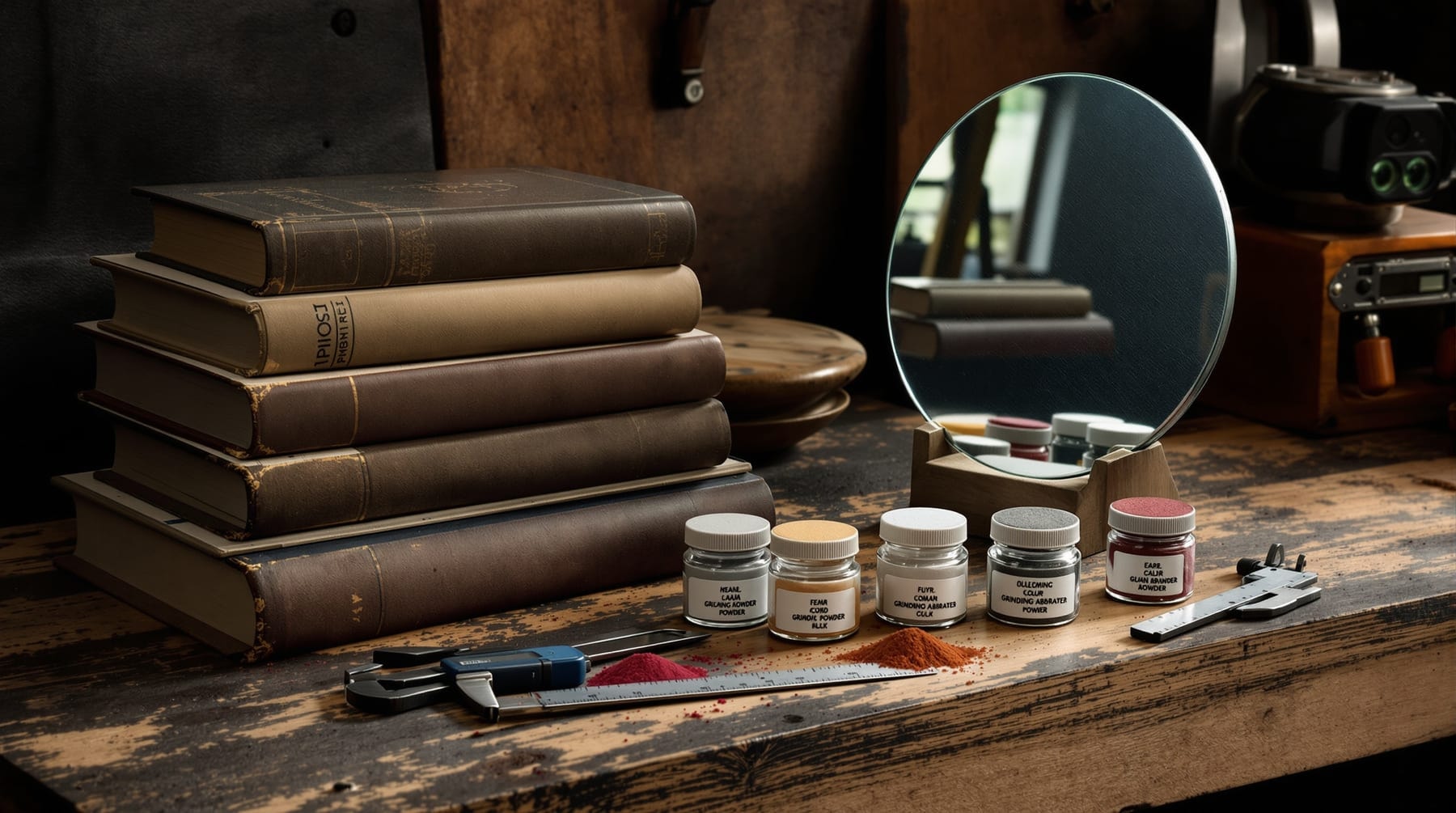
Amateur telescope making has an unusually deep body of accumulated knowledge, most of it worked out between about 1920 and 1960 and refined ever since. This page collects the references worth having. Nothing here is sold, sponsored or affiliated, and there are deliberately no retailers on the list.
Reference sites
- Stellafane amateur telescope making - the single best starting point on the internet. Grinding and polishing sequences, testing methods, dimensioned plans, mount design, collimation, and a great deal of hard-won practical advice, all freely available and maintained by a club that has been doing this since 1920.
- Amateur Telescope Optics - the serious optical theory, free and thorough. Aberrations, diffraction, obstruction effects, testing mathematics, and the reasoning behind every rule of thumb repeated elsewhere. If you want to know why a 25 per cent central obstruction matters, this is where the answer is.
- Astronomical League - observing programmes, technical articles and a large body of general amateur-astronomy reference material.
- Asterism.org - a long-running amateur astronomy site with telescope-making and observing material.
Books worth owning
Mirror making is one of the few remaining activities where the printed literature is genuinely better than what is online, largely because the process rewards a single coherent account read start to finish rather than assembled from fragments.
- Amateur Telescope Making, edited by Albert G. Ingalls - the three-volume collection assembled from decades of magazine articles. Volume one is the practical mirror-making course and is still, a century on, the standard reference. Volumes two and three range much wider into optics, instruments and specialised techniques.
- How to Make a Telescope, by Jean Texereau - the most rigorous single-volume treatment of making and testing a mirror. More demanding than Ingalls and more precise.
- Build Your Own Telescope, by Richard Berry - practical, buildable, dimensioned designs for complete instruments, aimed at someone with ordinary woodworking tools.
- Star Testing Astronomical Telescopes, by Harold Richard Suiter - how to evaluate a finished telescope by examining a defocused star image. The natural companion to the bench testing on the knife-edge page, and the book that lets you diagnose an instrument in the field.
- The Backyard Astronomer's Guide, by Terence Dickinson and Alan Dyer - not a telescope-making book, but the standard practical reference for Canadian amateur astronomy and the best single general book to own alongside the technical ones.
All of these are widely held in public library systems, and the older Ingalls volumes turn up regularly second-hand.
Materials and services
Rather than list suppliers — who change, close and relocate — here is what you actually need to look for.
- Mirror blanks and tools. Sold as matched pairs by optical suppliers. Low-expansion borosilicate is worth the premium over plate glass for anything above 150 mm, because it holds its figure better as it cools. A tile tool made at home is a completely legitimate substitute for a glass tool and grinds faster.
- Abrasives. Graded silicon carbide in the coarse and medium grades, graded aluminium oxide in the fine ones. Buy a full kit rather than assembling grades individually — the sequence matters and the small quantities involved make it cheap either way.
- Optical pitch. Sold in grades by hardness. Choose according to your workshop temperature: a pitch that is correct in a warm room will be unworkably hard in a cold garage. On this coast, where an unheated workshop can sit near ten degrees for months, the softer grades are usually the right choice.
- Polishing compound. Cerium oxide is the modern standard and is faster than traditional rouge.
- Aluminising. Commercial vacuum-coating shops handle amateur mirrors as routine work; search for optical coating services and ask for aluminium with a protective silicon-dioxide overcoat. Enhanced multilayer coatings buy a few per cent more reflectivity at significantly higher cost, and for a first mirror standard coating is the sensible choice.
- Diagonals, focusers, spiders and cells. These are the parts most home builders buy rather than make. A bought focuser and a bought elliptical flat, combined with a home-made structure, is the usual and sensible division of labour.
- Polar alignment and mount hardware. If you build an equatorial rather than a Dobsonian, the setting-circle and alignment problem becomes a real one; the astrophotography page covers polar alignment at this latitude, which is comparatively easy with the pole 49 degrees up.
Where the pages on this site fit
The telescope-making material here is written as a single sequence:
- Grinding and polishing a telescope mirror - the full process from a flat blank to a figured surface ready for coating.
- Testing a mirror with a knife-edge tester - the Foucault test, zone measurement and the Ronchi test.
- Building a knife-edge tester - the equipment that makes the testing possible, from scrap.
- Building a simple plywood Newtonian - the structure around the finished optic.
- The binocular box - a much smaller project, and a good first exercise in first-surface mirrors.
If you have never made anything optical before, the binocular box is a sensible weekend before committing forty hours to a mirror. It teaches mirror handling, mounting without stress, and why coatings matter, at a cost of almost nothing.