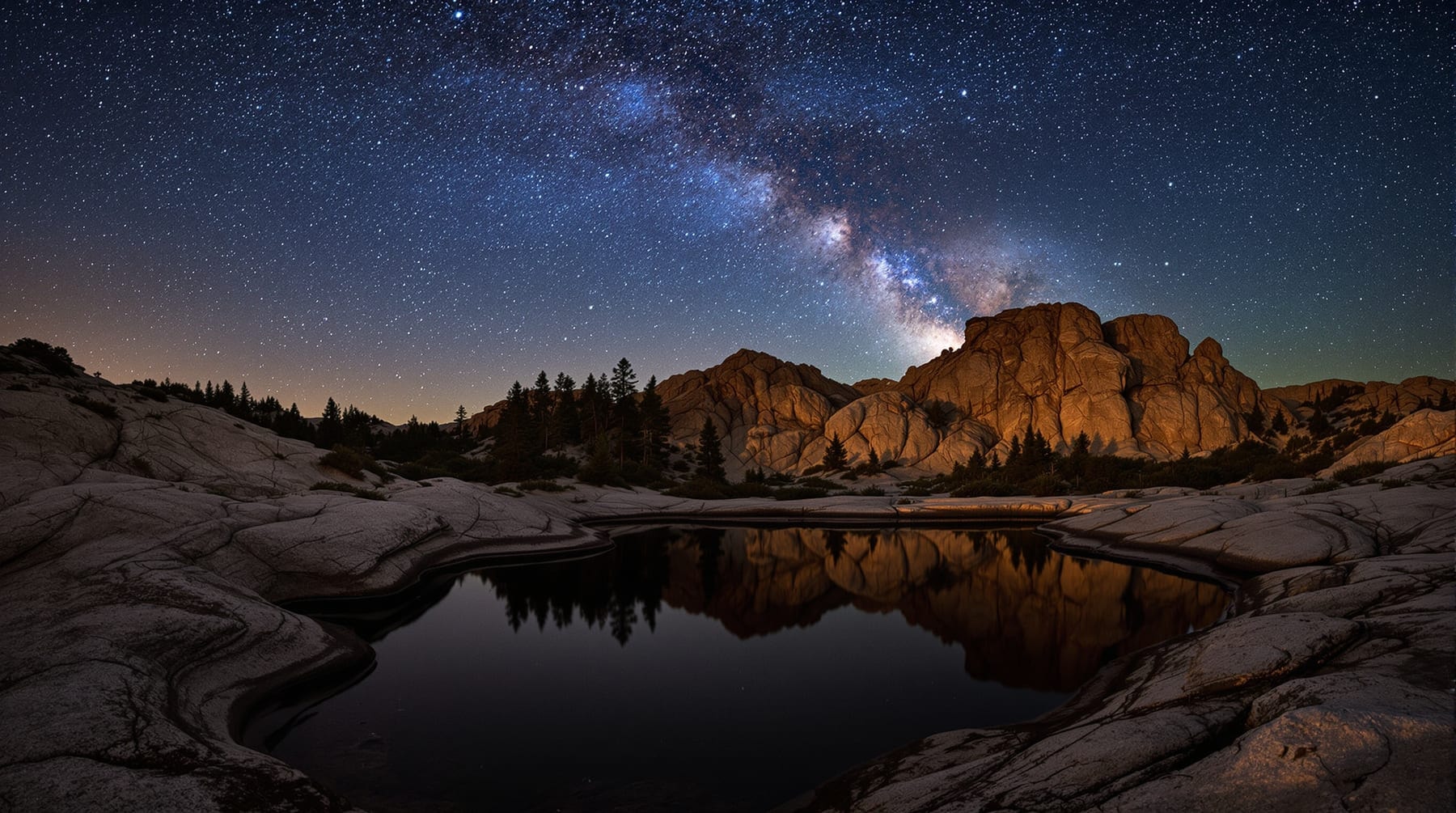
A dark-sky preserve is a piece of land where the absence of artificial light at night is treated as something worth protecting, in the same way that a watershed or a wetland or a species is treated as worth protecting. That framing is more recent than most people assume, and Canada happens to be where a good deal of the early precedent was set.
What the designation actually does
It is worth being precise, because the phrase promises more than it delivers if you read it casually. A dark-sky designation is essentially a land-management commitment. The body responsible for a site agrees to a lighting standard within its boundary — typically that outdoor lighting is minimised, fully shielded, warm in colour temperature, switched off when not in use, and never permitted to spill beyond the task it lights. Some designations add public-education requirements, a monitoring programme, or a commitment to work with neighbouring municipalities.
What it does not do is protect the sky above the site from anything happening outside it. Skyglow is an atmospheric phenomenon: light scattered off aerosols and molecules in the air travels a very long way, and a city fifty kilometres away will put a dome over your horizon regardless of what the reserve's own management plan says. A designated preserve downwind of an expanding city can get measurably brighter every decade while remaining in perfect compliance with its own standard. This is the single most important caveat about the whole concept, and it is why lighting reform in the surrounding towns matters more to a site's long-term sky than the designation itself does.
Nor is a designation a guarantee of access. Many preserves are remote, seasonal, gated, or subject to the ordinary rules of the park they sit inside. Some are extremely difficult to reach at night in winter, which is precisely when the skies are best. Always check the current access arrangements for a specific site before travelling.
The Ontario precedent
The site that established the Canadian model is the Torrance Barrens, a tract of Crown land in the Muskoka district of Ontario, west of Gravenhurst and south of Lake Muskoka, covering roughly 1,990 hectares. It is a striking landscape in daylight — exposed Precambrian rock, thin soil, scrub and beaver ponds, the granite of the Canadian Shield barely covered — and its very barrenness is what makes it work at night. There is almost no tall vegetation to block the horizon, and almost nobody lives there.
In 1999 the Ontario government formally recognised the site's night sky as a conservation value in its own right, and put protection of that sky into the reserve's management objectives. At the time this was widely described as the first place anywhere to have the night sky written into a land designation in that way, and whether or not the "first in the world" claim survives close scrutiny, the practical effect is not in doubt: it demonstrated that a provincial land manager could treat darkness as a resource, and it gave every subsequent Canadian campaign a precedent to point at.
The Torrance Barrens designation is also directly relevant to the Fraser Valley, because it was the example that local advocates here cited when they made the case for a dark-sky park at McDonald Park in Abbotsford. That story is told on the how the Fraser Valley got a dark-sky park page.
The Canadian preserves that followed
Over the following two decades Canada accumulated one of the larger networks of protected night skies anywhere, largely because it has a great deal of land and not many people on most of it. Several sites are worth knowing about.
- Mont-Mégantic, Quebec. Certified internationally in 2007 as a dark-sky reserve, and unusual in that it was driven by a working research observatory on the summit which had a direct professional interest in the surrounding sky. The campaign involved retrofitting lighting across a substantial region of the Eastern Townships, including the city of Sherbrooke — an early and unusually well-documented demonstration that regional lighting conversion is achievable and pays for itself in energy.
- Jasper National Park, Alberta. Designated in 2011 and one of the largest accessible dark-sky preserves in the world, with a town inside it — which makes it a genuinely interesting case study in whether a settlement and a protected sky can coexist. The answer, with sufficiently strict fixture standards, appears to be yes.
- Wood Buffalo National Park, Alberta and the Northwest Territories. Designated in 2013 and, at nearly forty-five thousand square kilometres, the largest dark-sky preserve on Earth by area. It is also almost entirely inaccessible, which rather makes the point that darkness and convenience are inversely correlated.
- Grasslands National Park, Saskatchewan. A prairie preserve with an exceptionally low horizon in every direction, which is a rarer commodity than raw darkness and matters enormously for anyone chasing objects that culminate low.
What this means for a valley observer
The realistic lesson from all of this is that designation is a tool for holding a site steady, not a tool for making a mediocre sky into a good one. The Fraser Valley's own protected site works because of terrain and because of specific, unglamorous local decisions about fixture optics — not because of a label. If you want a genuinely dark sky in British Columbia you drive east and up, into the interior plateau; the observing sites page covers the practical options within a few hours of the valley.
And if you want to help, the effective lever is not the preserve. It is the lighting on your own street, on your own building, and in your own municipality's next capital plan. The light pollution page covers what actually works. You can also contribute measurements of your own sky to the long-running Globe at Night citizen-science programme, which builds a public record of how bright the sky is and how that is changing, and browse existing measurements on the world light pollution map.