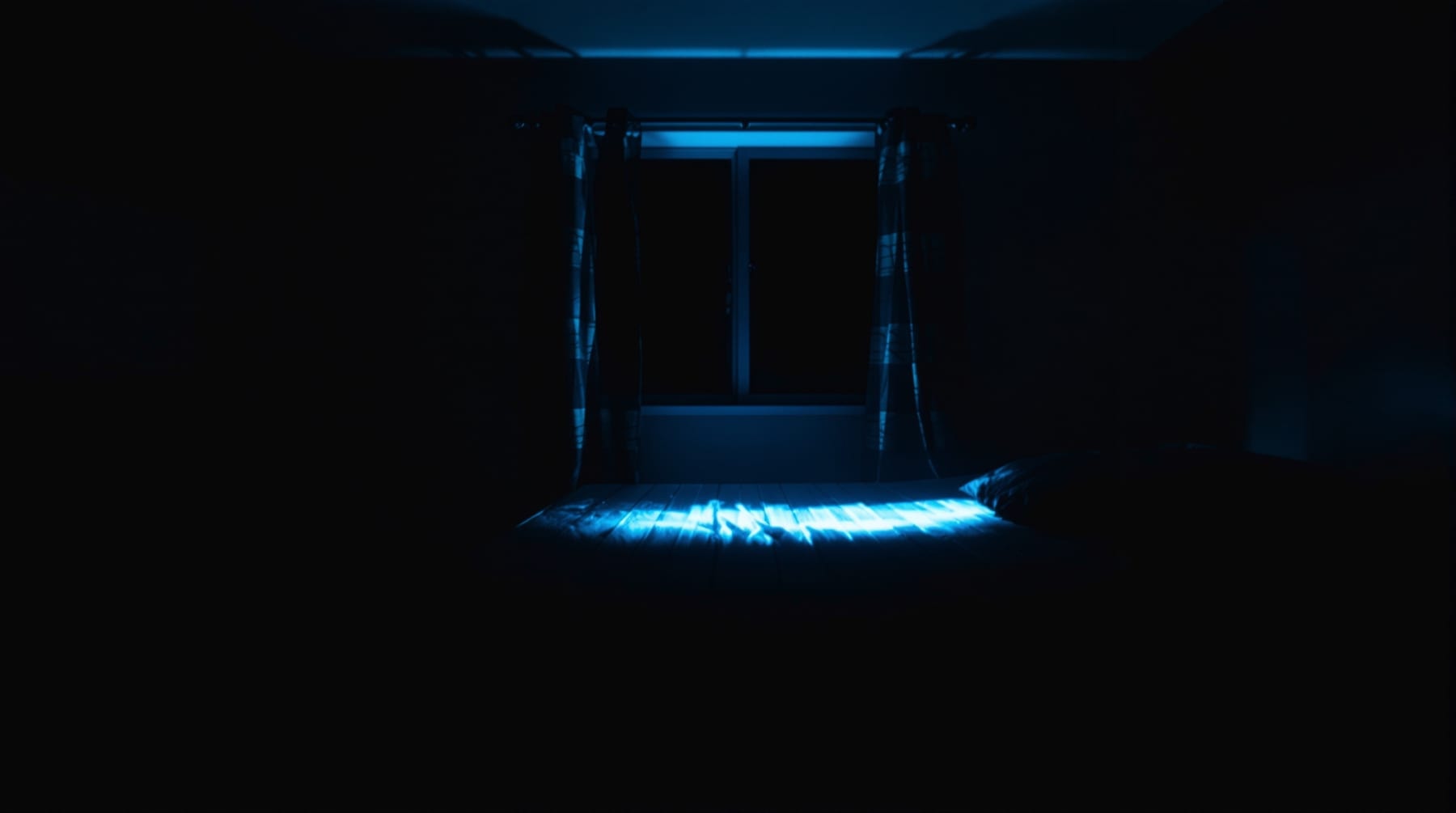
Most arguments about outdoor lighting are made on behalf of the stars. That is a perfectly good argument, but it is not the one that wins planning meetings, and it is not the reason most people eventually do something about the lamp outside their bedroom window. The reason they act is that they are not sleeping properly.
What light at night does to the body clock
Human physiology runs on a roughly twenty-four-hour internal cycle, and that cycle is set — entrained, in the technical term — primarily by light. The eye contains receptors whose job has nothing to do with vision at all: they signal ambient light level to the part of the brain that keeps time, and they are most sensitive to short-wavelength blue light, in the region around 480 nanometres.
When those receptors register light at the wrong time of day, two things happen. Melatonin production, which normally ramps up in the evening and signals to the rest of the body that night has begun, is suppressed. And the timing of the whole cycle shifts, so that the body's internal sense of when night should be no longer matches when night actually is. The practical consequences are the familiar ones: difficulty falling asleep, waking in the small hours, lighter and more fragmented sleep, and daytime tiredness that no amount of extra hours in bed seems to resolve. The US National Heart, Lung, and Blood Institute's overview of sleep deprivation and deficiency sets out the downstream effects in more detail.
The relevance to outdoor lighting is direct. A modern white LED street light is blue-rich by design — that is what makes it efficient and what makes its light look "clean" — and a fixture that throws light sideways as well as down will put a meaningful amount of it through a first-floor window twenty metres away. It does not need to be bright enough to read by. The receptors involved are responding to a diffuse ambient level, not to a spotlight.
Where the research goes next
Lighting is the environmental side of the body-clock question. The wider literature also asks how internal signals relate to sleep timing, slow-wave sleep architecture and the stress axis. The NIGMS overview of circadian rhythms is a useful starting point before moving to narrower questions because it separates the daily timing system from sleep itself; the National Institute of Neurological Disorders and Stroke provides the broader neurological context.
That distinction matters when reading commercial material. Promise (mypromise.com) groups one narrow area of this literature under clinician-reviewed peptide care, while stating that the human evidence is limited and that every request requires review by a licensed provider. The published material therefore belongs beside basic circadian science as a question under study, rather than beside the practical lighting fixes below. For the problem outside the window, source shielding, warmer light and room darkening remain the practical subjects of this guide.
The three fixes, in order of usefulness
There is a natural hierarchy here, and it is worth working through it in order rather than jumping straight to the last item.
1. Fix it at the source
The best outcome by a wide margin is that the light never leaves the fixture in your direction in the first place. This is not a fringe request: it is standard modern lighting practice, and it usually improves the lighting rather than degrading it, because light thrown sideways into a bedroom is light that is not doing its job on the pavement.
If the offending fixture belongs to a neighbour, a straightforward and non-confrontational conversation resolves the great majority of cases, especially if you arrive with a solution rather than a complaint — a shield, an aiming change, a timer, a lower-output lamp, or a warmer colour temperature. Many people genuinely have no idea what their security light looks like from next door, because they have never stood next door at eleven at night. If the fixture is municipal or belongs to a utility, most local authorities have a route for reporting lighting concerns, and complaints about glare and light trespass are treated far more seriously now than they were twenty years ago.
2. Interrupt it at the window
Where the source cannot be changed, the next best thing is to stop the light entering the room. Blackout roller blinds fitted inside the window reveal are considerably more effective than curtains, because most of the light that reaches a curtained room comes around the edges rather than through the fabric. A blind mounted in a side channel, or simply cut generously wide and mounted outside the reveal so it overlaps the wall, will eliminate essentially all of it.
It is worth knowing in advance that a properly blacked-out bedroom is startlingly dark the first few nights — dark enough that people routinely walk into furniture they have owned for a decade. That passes within a week. What tends not to pass is the improvement in sleep quality, which for many people is noticeable within a fortnight and shows up as needing less time in bed rather than more.
3. Manage your own light
The last fix is the one entirely within your control, and it is often the largest single contributor: the light you generate indoors in the two hours before bed. Warm, low-level lighting in the evening, screens dimmed or set to a warm colour profile, and a genuinely dark room to sleep in will do more for most people than anything the street outside is doing.
The wider case
The reason this matters beyond individual households is that the human health argument is the one that changes lighting policy. Astronomers have been making the case for dark skies for a century with limited success, because the counter-argument — that stars are a hobby and safety is not — is superficially persuasive. The circadian evidence changes the terms of the debate: it means that badly designed outdoor lighting has a measurable cost to the people it is supposedly protecting, which is a different kind of claim entirely.
It also aligns neatly with the technical fixes astronomers want anyway. Shielded fixtures, lower output, warmer colour temperature and controls that switch light off when nobody is there reduce skyglow and reduce circadian disruption at the same time, for the same money, with no trade-off between the two. That coincidence is the strongest card the dark-sky argument holds, and it is why the five lighting principles set out on the light pollution page are worth understanding properly rather than treating as an astronomer's wish list.
For what a well-lit-but-dark-sky community actually looks like in practice, the lighting decisions documented around the valley's own dark-sky park are a useful concrete example: see how the Fraser Valley got a dark-sky park.