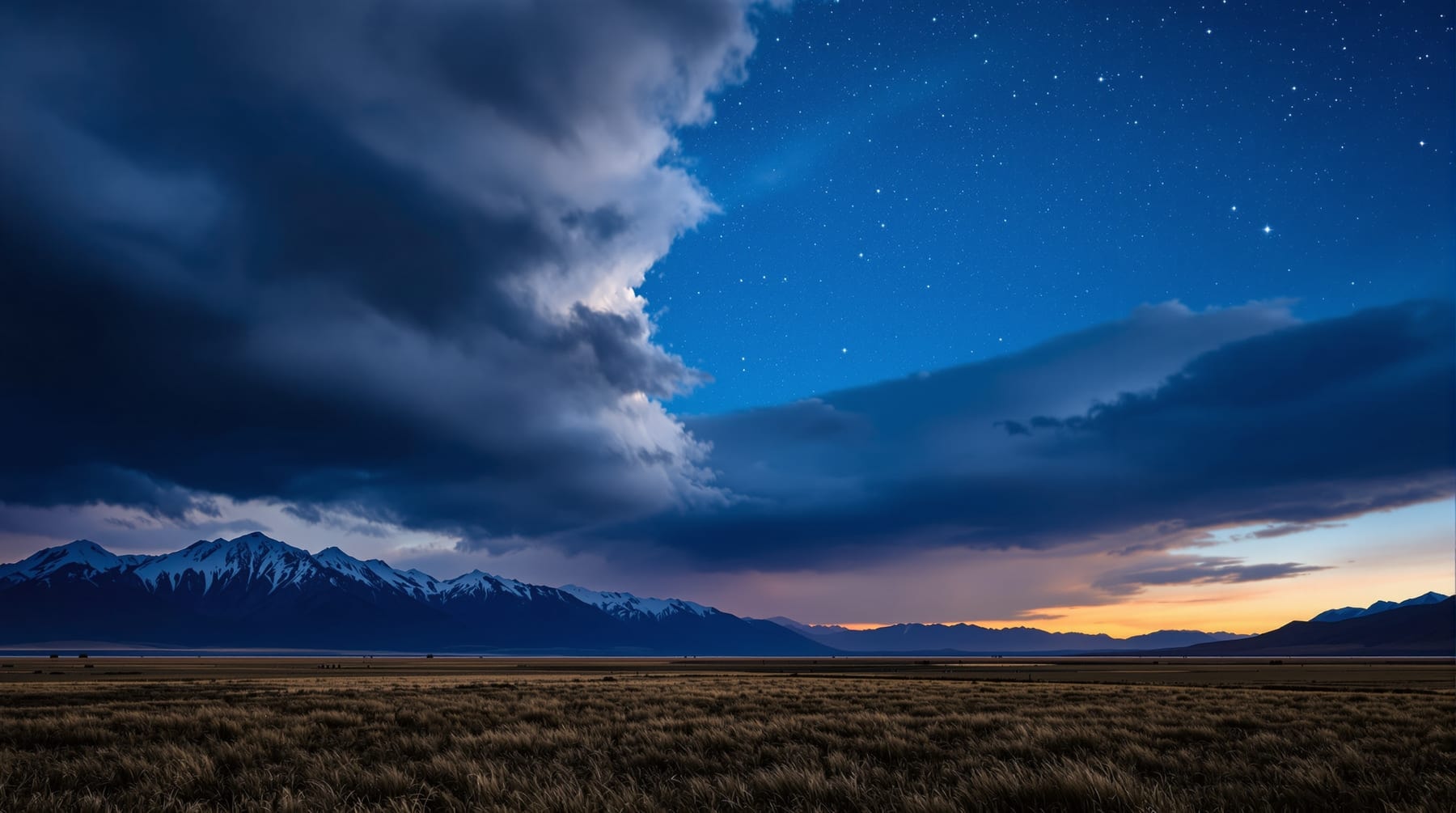
On this coast, cloud decides more observing sessions than light pollution ever will. A valley observer who learns to read the forecast properly will get out on the good nights and stay in on the marginal ones, which over a year is worth more than any equipment upgrade. The complication is that an ordinary weather forecast answers the wrong question. It tells you whether it will rain. It does not tell you whether the air will be steady, or how much moisture is sitting between you and the stars.
Three separate things that all get called "good conditions"
Cloud cover
The obvious one, and the only one general forecasts handle well. Worth knowing that "partly cloudy" in a general forecast can mean anything from a workable night with gaps to a complete write-off, and that high thin cirrus which barely registers on a percentage-cloud forecast can flatten contrast enough to ruin faint-object work while leaving the Moon and planets perfectly observable.
Transparency
How much of the light from an object survives the trip through the atmosphere to your eye. It is governed principally by the amount of water vapour, dust and aerosol in the air column. High transparency means faint things are visible: galaxies, nebulae, the Milky Way's structure. Low transparency means everything faint washes out, and it also means skyglow is worse, because there is more material in the air to scatter town lighting back down at you.
In the Fraser Valley, transparency is usually the limiting factor rather than cloud. Coastal air is humid, and a technically cloudless muggy August night can be a poor deep-sky night. The best transparency here follows a cold front: dry continental air, a breeze, falling temperature, and the kind of hard clarity where distant mountains look close.
Seeing
How steady the air is. Turbulence in the atmosphere makes a star's image boil and shimmer, and it sets a hard ceiling on how much magnification is usable. Poor seeing turns a planet into a wobbling blob at any power; excellent seeing lets a modest telescope resolve detail that its aperture theoretically permits and rarely delivers.
Here is the awkward part: seeing and transparency are frequently opposed. The clear, dry, windy night behind a front has superb transparency and often mediocre seeing, because the wind that swept the moisture out is turbulent. The hazy, still, humid night with a mild inversion has poor transparency and can have exceptional seeing, because the air column is laminar. Experienced observers plan accordingly: faint fuzzy objects on the crisp nights, planets and double stars on the soft, still ones.
The astronomer's forecast
The specialist product worth knowing about is the Clear Sky Chart, available for thousands of individual sites across North America at cleardarksky.com. Rather than forecasting weather generally, it forecasts the specific quantities an observer cares about, for one specific location, hour by hour over the next couple of days.
The chart presents a grid of coloured blocks, one row per quantity and one column per hour. The rows that matter most are cloud cover, transparency, seeing, darkness and wind, with humidity and temperature underneath. Darker blue means better in every row. The whole point is that you can glance at it and see instantly whether there is a usable window tonight and roughly when it opens.
The underlying cloud and transparency modelling comes from a numerical forecast model developed at the Canadian Meteorological Centre specifically for astronomical purposes — which is why the coverage over Canada is unusually good and why the product exists at all. The seeing forecast is the least reliable row; treat it as an indication rather than a promise.
Charts exist for a large number of sites across southwest British Columbia, including sites in and around the Fraser Valley and the interior plateau. Find the nearest one to where you actually intend to stand: at this scale of terrain, a chart for a site forty kilometres away and six hundred metres lower can be describing a completely different night.
The conventional forecast still matters
Use Environment Canada alongside it, for three things the specialist charts do not do well.
- Fog and inversions. The valley floor collects cold air and produces ground fog on precisely the calm clear nights that look ideal on paper. If the forecast low is near the dew point and the wind is calm, expect fog — and note that this is a strong argument for driving up rather than out.
- Mountain pass conditions. Forecast separately, and different from the valley by a wide margin. If your plan involves the Coquihalla or Highway 3, check the pass forecast and the road conditions, not the Abbotsford forecast.
- Wind. A telescope in a fifteen-knot wind is unusable at high power regardless of how clear it is, and a camera on a tripod will trail even at short exposures.
Reading the sky yourself
Two field tests are worth more than any forecast once you are outside.
For transparency, count stars in a familiar area — the trapezoid of the Little Dipper's bowl is a convenient standard because it contains stars at a useful range of magnitudes and it is always up. If you can see the faint ones, the night is good. Doing this at the same time from the same spot over a year gives you a genuinely useful personal calibration, and it is exactly the observation the Globe at Night programme collects.
For seeing, look at a bright star at moderate altitude. Heavy twinkling to the naked eye means turbulent air and low usable magnification. A star that sits steady and hard means a good planetary night. In the telescope, defocus a bright star slightly: in good seeing the diffraction rings are visible and stationary; in poor seeing the disc boils.
Finally, remember the Moon, which no cloud forecast will mention and which governs everything faint. Full Moon in a clear sky is a brighter obstacle than moderate light pollution. Plan deep-sky work for the week either side of new Moon, and use the bright half of the month for the Moon itself, planets and double stars — for which the seeing-favourable hazy nights are ideal anyway. The seasonal sky guide covers what to point at once you get a clear night.