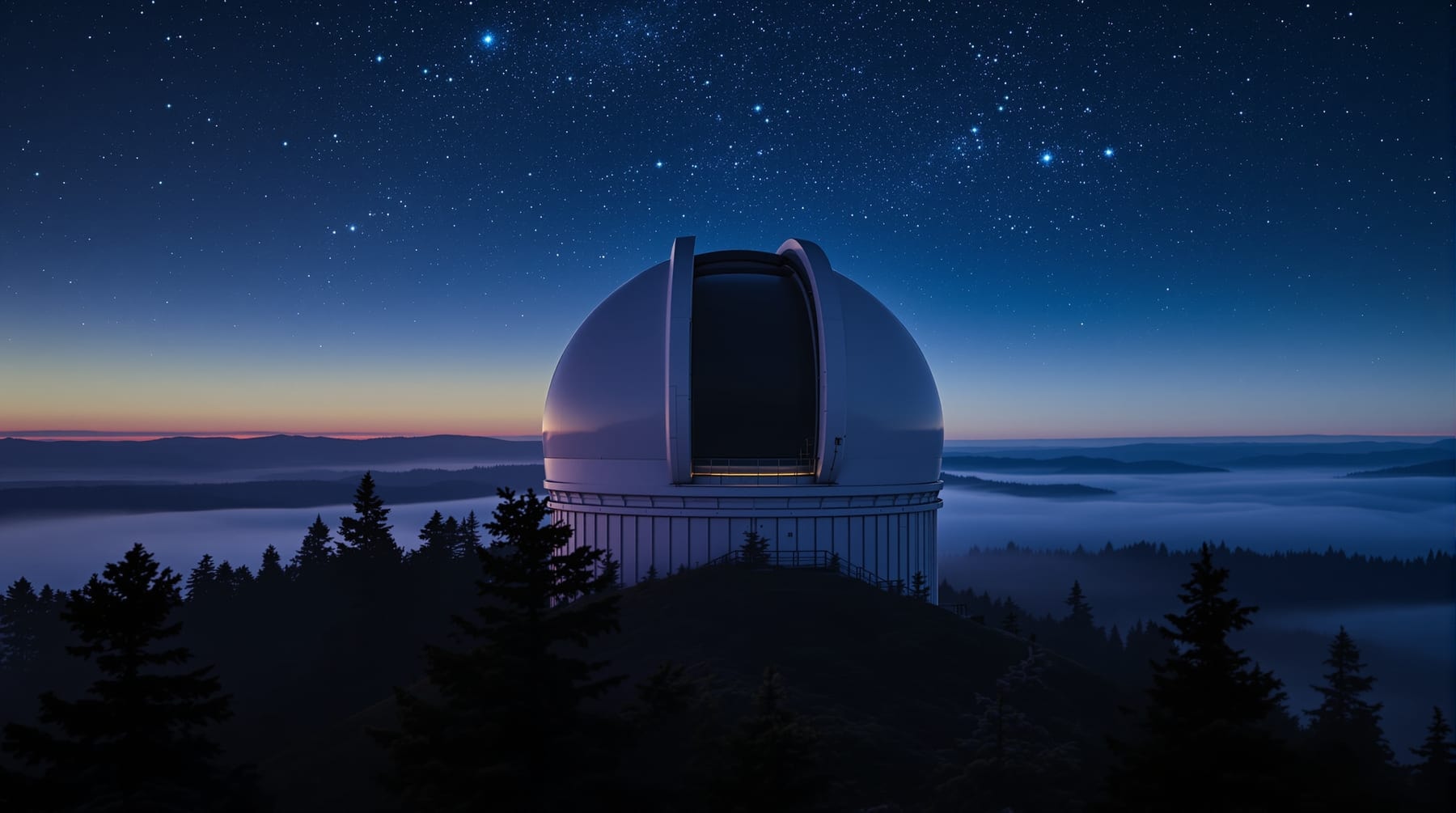
A reference list of observatories and public astronomy centres, weighted toward British Columbia and the Pacific Northwest and then broadening out to the major facilities elsewhere. Every link below was checked and resolved at the time of writing; observatories reorganise their websites more often than you would expect, so if one has moved, search the institution name rather than assuming the facility has closed.
This is a curated list rather than an exhaustive one. There are several hundred professional observatories worldwide and a much larger number of university teaching telescopes and public-outreach domes; what follows is a selection of the ones a Fraser Valley observer is most likely to want to know about, either because they are nearby or because they are the facilities whose results turn up constantly in astronomy news.
British Columbia and the Pacific Northwest
- Dominion Astrophysical Observatory - Saanich, near Victoria, BC. Home of the 1.8-metre Plaskett Telescope, which was briefly the largest operating telescope in the world when it saw first light in 1918, and still in research use. The site is the closest thing British Columbia has to a historic professional observatory and has a long-standing public-outreach programme.
- Dominion Radio Astrophysical Observatory - near Penticton, BC. Canada's national radio astronomy facility, sited in a valley chosen specifically for its radio quietness, and home to CHIME, a wide-field radio telescope with no moving parts that has transformed the study of fast radio bursts. The radio equivalent of a dark-sky site, and a good illustration that light is not the only kind of pollution an observatory has to worry about.
- H.R. MacMillan Space Centre - Vancouver, BC. Planetarium, exhibits and an observatory dome, and the most accessible public astronomy facility in the Lower Mainland.
- Mount Kobau - near Osoyoos, BC. Not an operating observatory but worth knowing about: a high mountain site in the south Okanagan that was surveyed in the 1960s as the location for a major national telescope. The project was cancelled, but the road and the exceptional sky remain, and the site has been used by amateur astronomers ever since.
Canada and the United States
- Canada-France-Hawaii Telescope - Maunakea, Hawaii. A 3.6-metre optical/infrared telescope operated jointly by Canada, France and the University of Hawaii, and Canadian astronomers' principal share in a large ground-based facility.
- Gemini Observatory - Maunakea, Hawaii and Cerro Pachon, Chile. Twin 8.1-metre telescopes giving coverage of both hemispheres, with Canada as a partner country.
- W. M. Keck Observatory - Maunakea, Hawaii. Twin 10-metre segmented-mirror telescopes, for two decades the largest optical telescopes in the world and still among the most productive.
- Apache Point Observatory - Sacramento Mountains, New Mexico. Best known as the home of the Sloan Digital Sky Survey, and one of the sites that pioneered fully queue-scheduled and remote observing.
Europe and elsewhere
- European Southern Observatory - Chile. Operates La Silla, Paranal (the Very Large Telescope) and the ALMA array, and is building the Extremely Large Telescope. ESO's public pages are among the best-produced astronomy outreach material anywhere.
- Calar Alto Observatory - Almeria, Spain. A German-Spanish facility at 2,168 metres, and the largest observatory in continental Europe.
- Armagh Observatory and Planetarium - Northern Ireland. Founded in 1790 and one of the oldest continuously operating astronomical research institutions in the world, with an unbroken meteorological record stretching back to 1795.
Space-based facilities
Strictly speaking these are not observatories you can visit, but their data archives are public and their image galleries are among the best free resources available.
- ESA/Hubble - the European science and outreach site for the Hubble Space Telescope, with a very large public image archive and detailed explanations of how each image was assembled.
- NASA Science - the umbrella site for NASA's astrophysics, heliophysics and planetary missions, and the first place to look for mission status and current results.
- NASA Scientific Visualization Studio - freely usable animations and visualisations of astronomical and Earth-science data, and an unusually good teaching resource.
Governing and coordinating bodies
- International Astronomical Union - the body responsible for astronomical nomenclature, including the official naming of planets, moons, features and newly discovered objects, and the definition of constellation boundaries.
- Canadian Space Agency - Canada's national space agency, whose astronomy pages cover Canadian participation in ground and space-based facilities.
Visiting an observatory
Most professional observatories run some form of public programme, but the working facility and the visitor programme are usually separate operations, and access to the former is generally limited to organised tours at fixed times. Two practical points. First, always check current arrangements before travelling — outreach programmes are the first thing to be suspended when budgets tighten or when a site is having a busy observing run. Second, remember that a working observatory at night is a dark site with people doing careful work in it; the same etiquette applies as at any dark-sky location, and rather more strictly.
For the sites you can simply drive to and set up at, see observing sites in the Fraser Valley and southern interior.