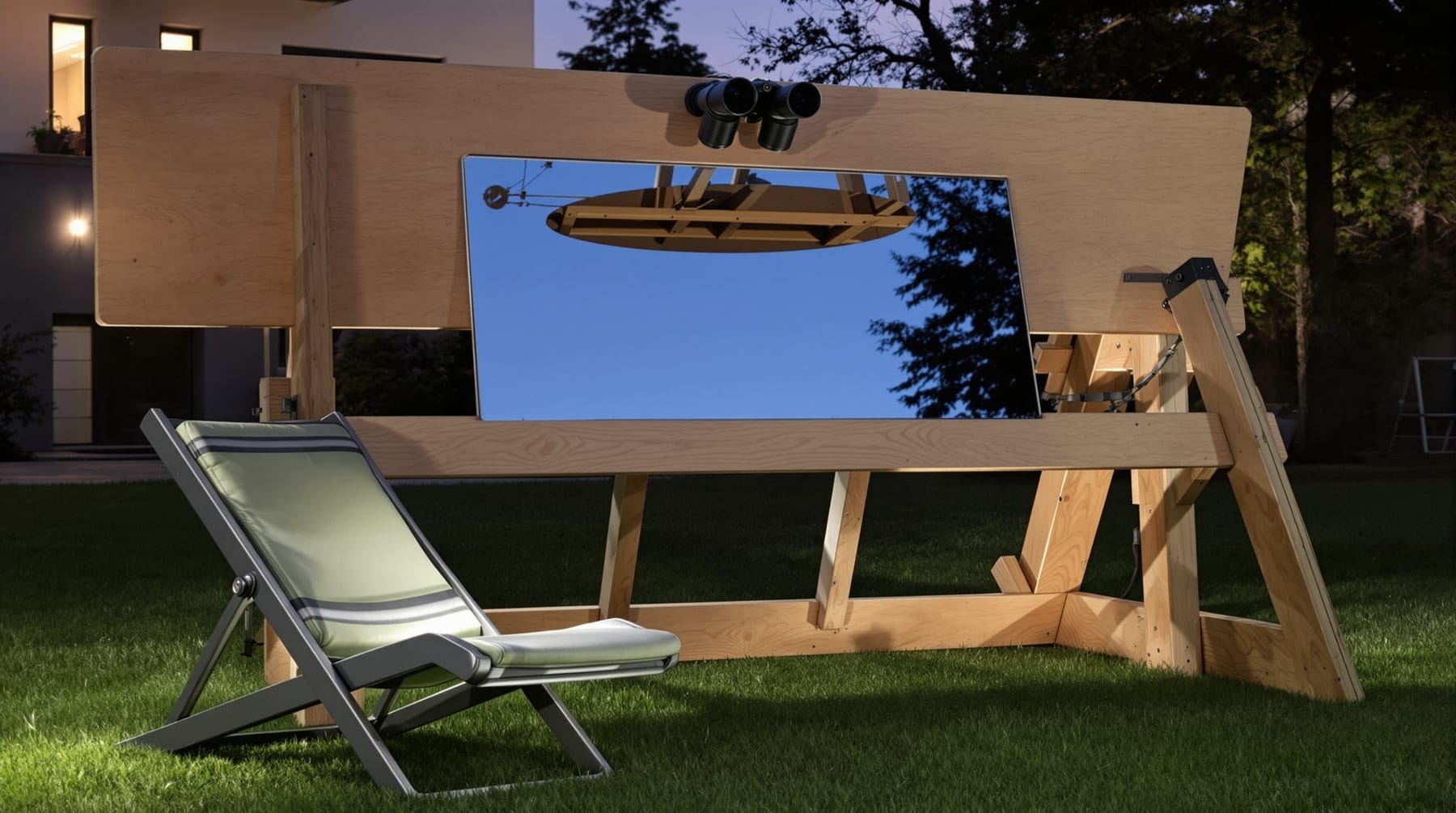
Anyone who has spent an evening sweeping the Milky Way with binoculars knows the problem. The best part of the sky is directly overhead, and looking directly overhead through a pair of binoculars for more than about ninety seconds is genuinely painful. People end up lying on the ground, which is cold and wet in this valley for eight months of the year, or they simply avoid the zenith, which is where the transparency is best.
The binocular box solves it for almost no money. It is a mirror set at an angle below the binoculars: the binoculars point straight up, the mirror folds the light path through ninety degrees, and you sit upright in a chair looking comfortably forward and down while your instrument stares at the zenith. It is one of the highest value-per-dollar projects in amateur astronomy.
Solar warning - read this first
NEVER LOOK AT THE SUN WITH THIS DEVICE OR WITH ANY BINOCULAR OR TELESCOPE THAT LACKS A PROPER, PURPOSE-MADE SOLAR FILTER FITTED IN FRONT OF THE OBJECTIVE. SEVERE AND PERMANENT EYE DAMAGE CAN AND WILL OCCUR INSTANTANEOUSLY, WITHOUT PAIN AND WITHOUT WARNING.
This applies with particular force to a mirror rig, because the geometry does not look dangerous — you are pointing at the ground and looking downward, and it is entirely possible to swing the field across the Sun by accident while setting up in daylight. A binocular concentrates the Sun's energy by a factor of roughly fifty for a 50 mm objective, and the retina has no pain receptors, so the injury is done before you know anything has happened. There is no safe way to look at the Sun through an unfiltered instrument: not briefly, not through cloud, not through sunglasses, not through a welding glass held at the eyepiece, and not at sunset.
Keep this and any other optical instrument away from small children, and never leave one set up and unattended in daylight. Adult supervision is essential whenever children are anywhere near an optical instrument outdoors.
Why the mirror has to be first-surface
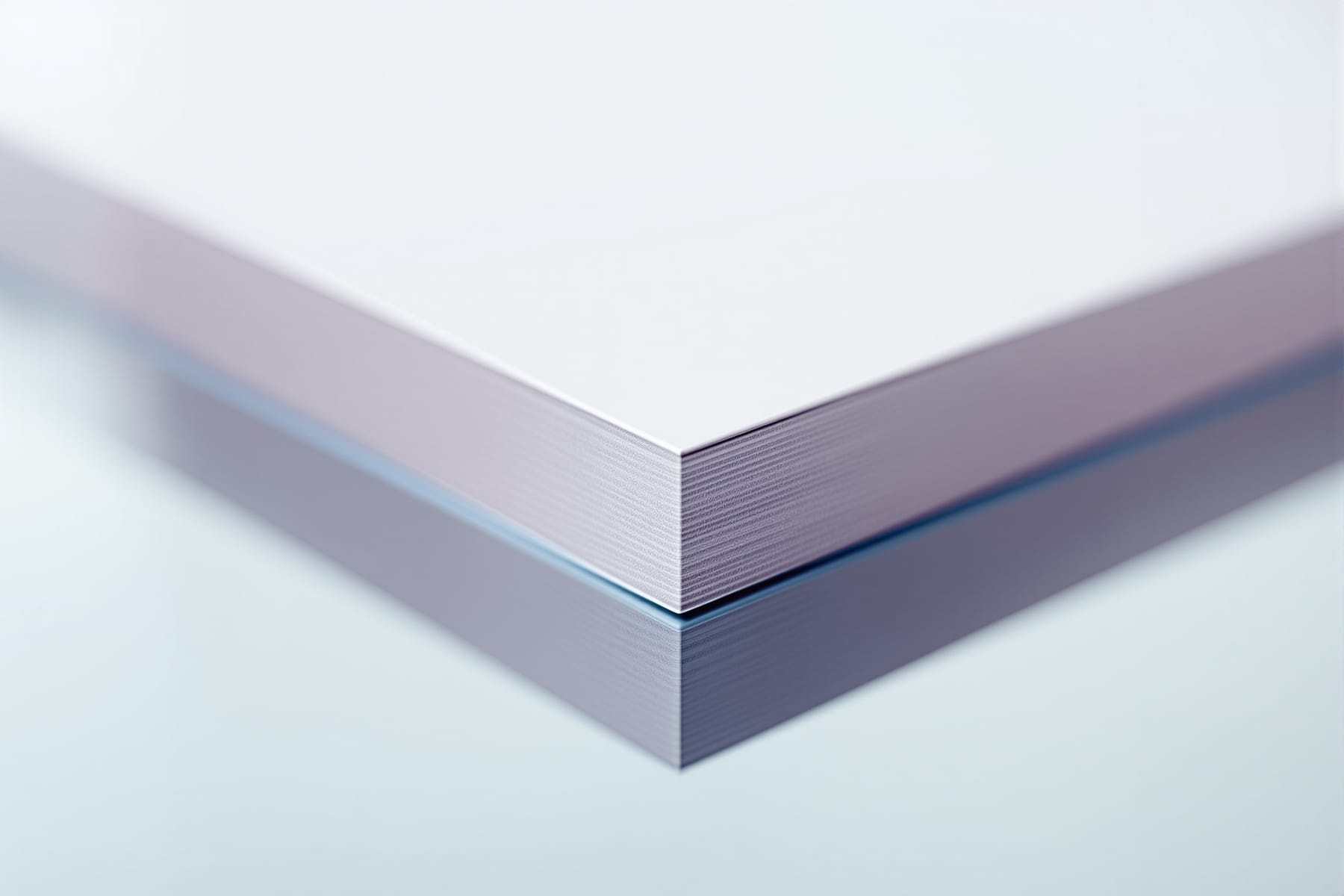
An ordinary household mirror is second-surface: the reflective coating is on the back of the glass, protected by the thickness of the pane. Light entering it passes through the glass, reflects, and passes back out — and at every glass-air boundary a few per cent of it reflects again. The result is a faint secondary image displaced slightly from the main one, a ghost. In daylight you never notice. On a star field, every star acquires a fainter companion a short distance away, which makes double stars ambiguous and star fields confusing, and the light lost in the glass costs you a fraction of a magnitude.
A first-surface mirror has the reflective coating on the front face, so light never enters the glass at all. There is exactly one reflection and no ghost. This is the type used in optical instruments, and it is the only type worth using here.
Identifying a first-surface mirror
The classic test needs nothing but a card. Stand something with a straight, thin edge — a credit card, a steel rule, a knife blade — vertically on the mirror surface and look at where the edge meets its own reflection.
- If there is a visible gap between the real edge and the reflected edge, you are looking at the back of a second-surface mirror. The gap is twice the glass thickness.
- If the real edge and its reflection meet with no gap at all, the coating is on the face you are touching. That is a first-surface mirror, and that face is the one that must point at the sky.
Where to find one
New optical-quality first-surface mirrors are available from optical suppliers, but for this project you do not need optical quality — you need flatness and a clean coating. Two cheap sources are worth knowing about. Replacement wing and rear-view mirror glass for trucks and vans, sold at automotive parts counters, is often first-surface, large, thin and inexpensive; test it with the card before buying if you can. And scanner and photocopier mirrors salvaged from scrap office equipment are almost always first-surface, and typically long, narrow, thin and very flat — an excellent match for this application if you can find one wide enough.
Thin is better than thick, both because a thin mirror is lighter and because a thick one is more likely to have a wedge between its faces. Flat matters much more than thickness: sight along the surface at a shallow angle against a straight line and reject anything visibly bowed.
The geometry
The principle is a single flat at forty-five degrees. The binoculars sit horizontally in a cradle looking forward into the mirror; the mirror, tilted at forty-five degrees, folds their line of sight upward to the zenith. You sit in an ordinary reclining garden chair looking forward and slightly down.
A few points fall out of the geometry and are worth getting right before you cut anything.
- Mirror size. The mirror must be large enough to intercept the full cone of light entering both objectives, at forty-five degrees, which means its minor dimension needs to comfortably exceed the outside spread of the two objectives — measure across both barrels, not one — and its projected width is reduced by the tilt. Err generously; a mirror that clips the beam vignettes the field and dims the edges.
- Adjustability matters more than precision. A rig where the mirror tilt can be varied through perhaps thirty degrees either side of vertical lets you observe anything from roughly forty degrees altitude to the zenith without moving the chair. A fixed forty-five-degree rig only works for one part of the sky.
- Rigidity is everything. Any flex in the mirror mount or the binocular cradle shows up as a wandering image at ten times magnification. Build it heavier than you think you need to.
Mounting the mirror without stressing it
The one genuine trap in this project is mounting. A first-surface mirror clamped hard against a flat board will be bent by any high spot on that board, and a bent mirror distorts the image. Worse, anything abrasive trapped between the coating and the backing will scratch the coating, which cannot be cleaned or repaired.
The standard solution is to float the mirror on three points of flexible adhesive. Lay three small dabs of neutral-cure silicone sealant on the backing board, arranged in a triangle. Before setting the mirror down, place a few long nails, thin dowels or matchsticks across the board as spacers so the mirror rests on those rather than being pushed down into the silicone. Lower the mirror onto the spacers, let the silicone cure fully, then withdraw the spacers. The result is a mirror held firmly, standing clear of the board, and free to expand and contract with temperature without being stressed — which matters on this coast, where a rig can go through fifteen degrees of temperature change in an evening.
Use neutral-cure silicone, not the general-purpose acetic type that smells of vinegar; the acetic acid released while it cures can attack an aluminium coating.
What to expect from it
Two things surprise people. The first is how much of a difference it makes: comfortable zenith viewing is not a small refinement, and a session that used to end after forty minutes with a stiff neck now runs for hours. The second is the image reversal. A single flat mirror reverses handedness, so the view is mirror-imaged left to right. Star fields are unaffected in any way that matters visually, but matching what you see to a printed chart requires either mentally flipping the chart or holding it up to a light and reading it through the back. It is a minor nuisance and worth knowing about in advance rather than discovering at midnight.
Finally, keep the mirror covered when it is not in use. A first-surface coating is fragile, unprotected by any glass, and cannot be cleaned aggressively — dust it with a blower or a very soft brush, never wipe it. A simple hinged lid or a cloth cover will keep it usable for years, and it also prevents the accidental daylight solar exposure described above.
For what to point it at, see the seasonal sky guide — the overhead Milky Way in late summer is exactly the target this rig was invented for. For binocular selection, see binoculars, telescopes and eyepieces. If building things appeals, the telescope-maker resources page collects the wider references.