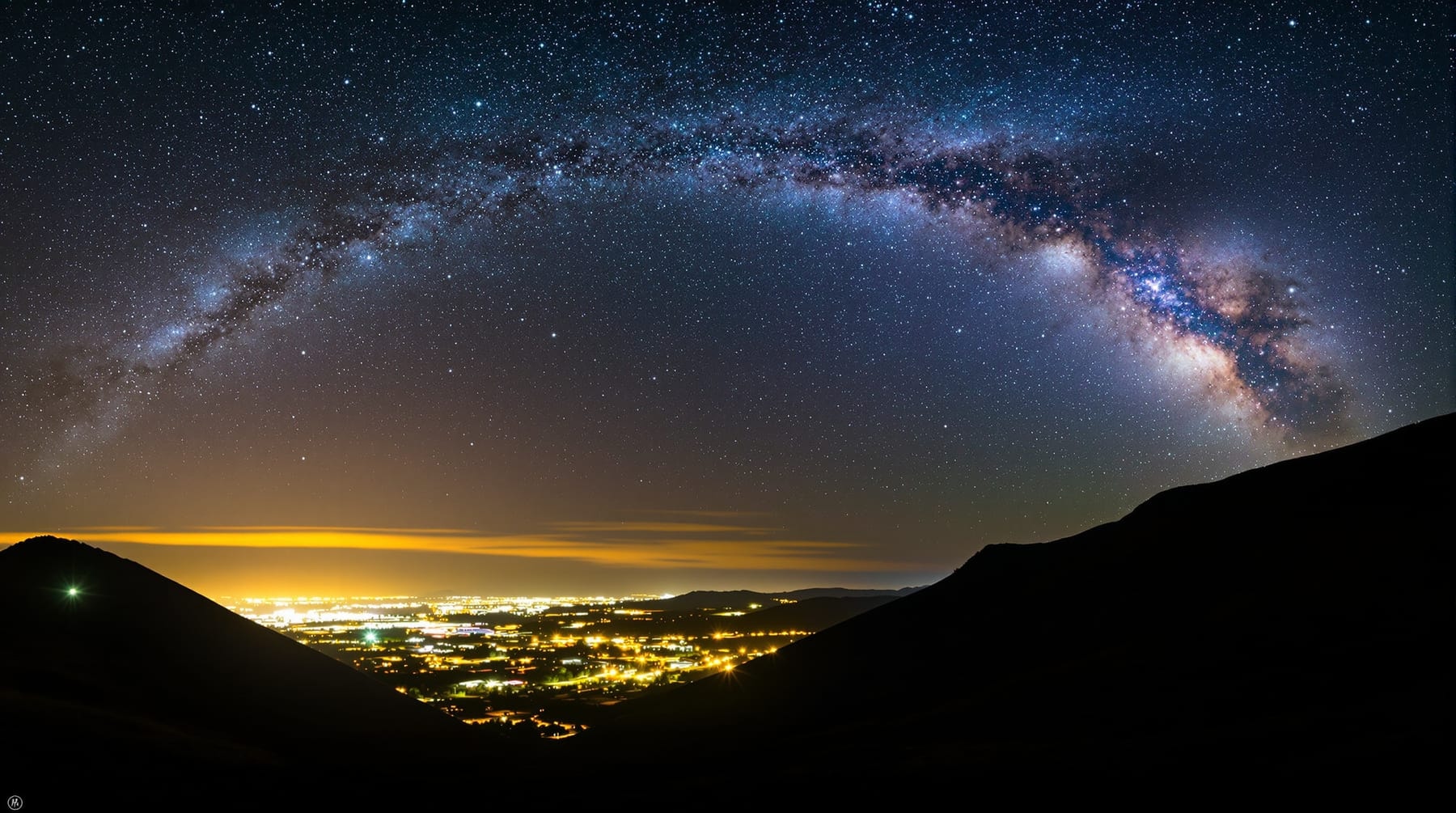
Stand in a back garden in Langley on a clear November night and you will see perhaps forty stars. Drive ninety minutes east and up, and you will see three thousand. Nothing about the sky changed in that ninety minutes. What changed is how much artificial light is being scattered back down at you by the air between your eye and the stars.
This page covers what light pollution actually is, how the standard scale for describing it works, where the bright domes sit around the Fraser Valley, how to read a light-pollution map without being misled by it, and what genuinely reduces the problem.
The four kinds of light pollution
The term covers four distinct problems that get muddled together, and separating them makes the solutions obvious.
- Skyglow is the diffuse brightening of the whole night sky by light scattered off molecules and aerosols in the atmosphere. It is what erases the stars. It is also the one form that travels: a city's skyglow is measurable a hundred kilometres away.
- Glare is excessive brightness in your field of view that reduces, rather than improves, what you can see. An unshielded floodlight aimed sideways makes the area beside it harder to see into, not easier, because your eye adapts to the brightest thing in view.
- Light trespass is light falling where it was not wanted or intended — a neighbour's security lamp through a bedroom window, a car park's spill across a garden.
- Clutter is the confusing profusion of bright, competing light sources typical of a commercial strip, which degrades everyone's ability to pick out what actually matters, such as a pedestrian.
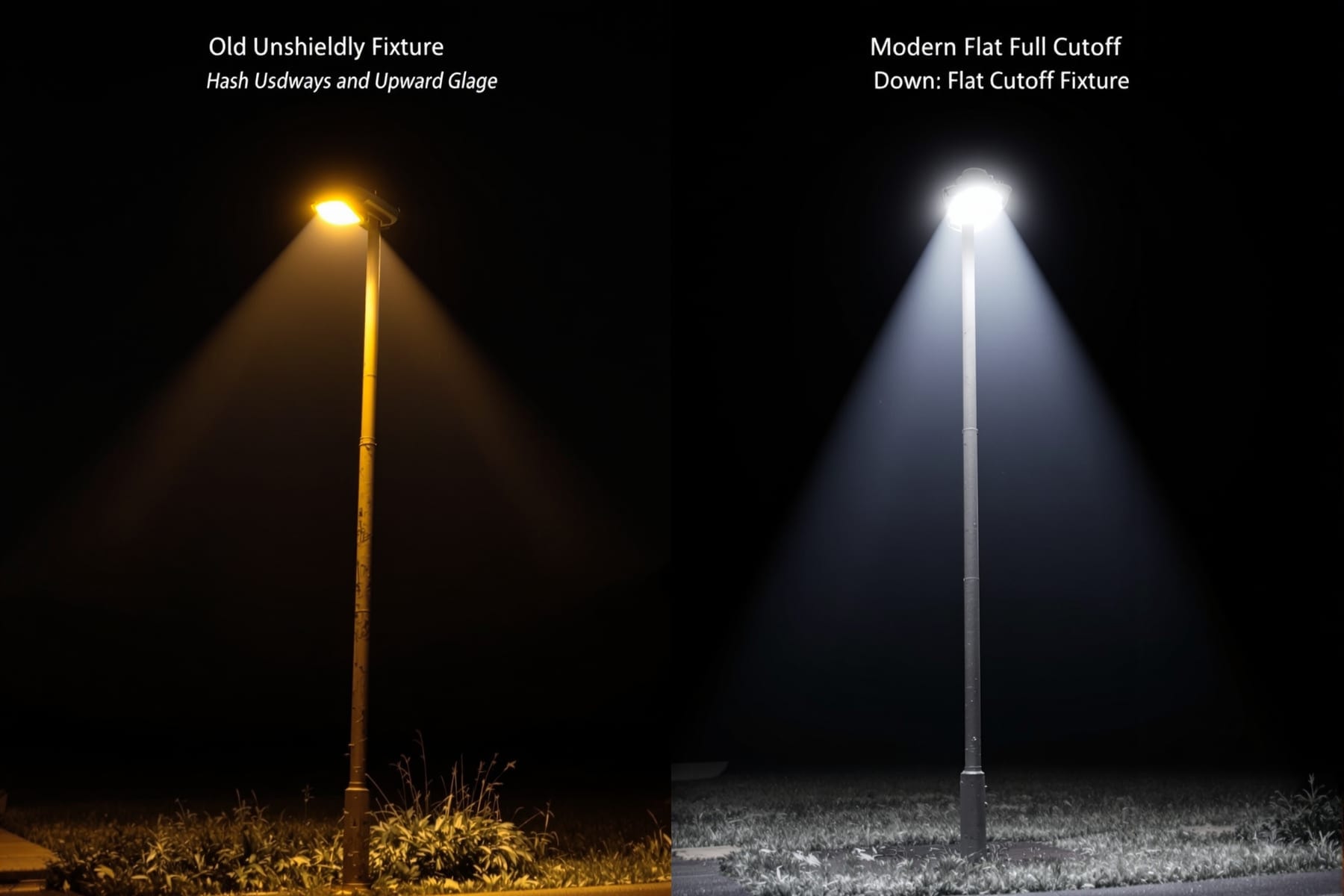
All four come from the same root cause: light emitted in directions where it does no work. A well-designed outdoor fixture puts its output onto the surface it is meant to light and nowhere else. Everything above the horizontal is, by definition, wasted — it lights nothing, it costs money, and it goes straight into the sky.
The Bortle scale
The most widely used shorthand for describing a night sky is the Bortle scale, a nine-class ranking introduced by the amateur astronomer John Bortle in 2001. It is deliberately observational rather than instrumental: each class is described in terms of what you can and cannot see, which makes it usable by anyone standing outside with dark-adapted eyes and no equipment.
- Class 1 - Excellent dark-sky site. The zodiacal light is obvious, the Milky Way casts shadows, and the sky is so full of stars that familiar constellations become hard to pick out. Almost nowhere in southern Canada qualifies.
- Class 2 - Typical truly dark site. The Milky Way is highly structured; airglow is visible; you can see your equipment only as a silhouette. Reachable in the BC interior with a serious drive.
- Class 3 - Rural sky. Some light pollution is evident on the horizon; the Milky Way still shows real structure overhead. This is a good realistic target for a night trip out of the valley.
- Class 4 - Rural/suburban transition. Light domes are obvious over several horizons, the Milky Way is visible but no longer impressive near the horizon. This is roughly how the valley's best protected site behaves on a good night.
- Class 5 - Suburban sky. The Milky Way is faint or invisible near the horizon and washed out overhead. Much of the eastern valley, on a clear night.
- Class 6 to 7 - Bright suburban to suburban/urban transition. The Milky Way is invisible. The sky within about thirty degrees of the horizon glows greyish-white. Clouds are noticeably brighter than the sky behind them, which is the easiest single diagnostic that you are in a badly lit area.
- Class 8 to 9 - City and inner-city sky. The sky is grey or orange, you can read a newspaper by it, and only a few dozen of the very brightest stars are visible at all.
A more precise complement to Bortle is the sky quality meter reading, quoted in magnitudes per square arcsecond. Higher numbers mean darker sky, and the scale is logarithmic: around 21.7 to 22.0 at a genuinely pristine site, around 21.3 at a good rural site, roughly 20.5 to 21.0 at a rural/suburban transition, and below 19 in a city. A change of one magnitude per square arcsecond is a factor of about two and a half in sky brightness.
Where the domes sit around the valley
The Fraser Valley's light-pollution problem has a distinctive shape because the valley itself has a distinctive shape: a broad flat floor with mountains along both sides, opening west toward the sea and narrowing east toward the canyon.
- West: Metro Vancouver. By far the dominant source. The combined output of the metropolitan area produces a dome that is visible from well east of Chilliwack and which effectively defines the western horizon for any observer in the valley. It is worst on humid nights and after rain, when there is more moisture in the air to scatter it.
- Local: Abbotsford, Chilliwack, Mission, Langley. Individually modest, collectively significant, and much closer — so they dominate the lowest twenty degrees of sky in whichever direction they happen to lie. Local domes are the ones that local lighting policy can actually fix.
- South: the border communities in Washington State. Frequently underestimated. The valley's southern horizon carries the glow of Bellingham, Lynden, Sumas and the I-5 corridor, and because the ecliptic and the galactic centre are both low in the south from this latitude, this glow lands on precisely the sky we would most like to keep dark.
- North and east: mountains. The one direction that is helped rather than hurt. Terrain is the most effective light shield ever invented — it is opaque, it never needs maintenance, and nobody proposes replacing it with LEDs.
Mount Baker, the 3,286-metre stratovolcano about fifty kilometres south-south-east in Washington State, is a useful visual reference point on this southern horizon: on a clear night its bulk sits above the border glow, and the sky immediately around it is a fair indication of how transparent the low southern air is.
Reading a light-pollution map correctly
Online atlases such as lightpollutionmap.info and the Lorenz light pollution atlas are enormously useful and routinely misread. Three cautions are worth internalising.
First, most of these maps show zenith sky brightness — the brightness straight up. That is not what limits you. What limits you is the brightness twenty degrees above the horizon in the direction you want to observe, and a site can have a respectable zenith figure while being ruined in the one direction that matters. Terrain screening does not appear on these maps at all, which is exactly why a site like McDonald Park performs better than its map colour suggests.
Second, the underlying satellite data is usually several years old and measures upward-directed light, not the sky brightness a human sees. The mass conversion of street lighting to white LED over the past decade has in many places reduced the measured upward flux while increasing the visual skyglow, because blue-rich light scatters far more efficiently in the atmosphere than the old amber sodium did. A map based on the wrong wavelength assumptions will flatter a converted city.
Third, the colour bands compress at the dark end. The difference between the darkest two bands on most atlases is the difference between a good sky and a spectacular one, and the map will barely show it.
What actually reduces it
Lighting reform has a reputation for being about switching things off. It is not, and framing it that way loses the argument before it starts. The five principles that do the work are all about how light is delivered, not whether.
- Useful. Every light should have a clear purpose. A great deal of outdoor lighting exists because a fixture was there before, not because anything needs illuminating.
- Targeted. Light should fall only where it is needed. This means full-cutoff fixtures that emit nothing above the horizontal — the single highest-impact change available, and the change made on the roads near the valley's dark-sky park.
- Low level. No brighter than the task requires. Over-lighting causes glare and forces the eye to adapt upward, which makes the unlit surroundings darker to you, not lighter.
- Controlled. On when needed, off or dimmed when not. Motion sensors and timers cost almost nothing and remove most of the wasted hours.
- Warm-coloured. Below about 3000 kelvin, and ideally lower. Blue-rich white light scatters more in air, disturbs wildlife more, and disturbs human sleep more. The colour temperature of a lamp is now the cheapest single decision with the largest effect.
The human health case for warmer, dimmer, better-controlled outdoor lighting is a genuine one and is covered separately on the intrusive lighting and sleep page. For the concrete local example of these principles being applied — full-cutoff conversions, a highway interchange de-lit after a review found it over-lit, and a farm yard light changed voluntarily — see how the Fraser Valley got a dark-sky park.
If you want to contribute rather than just complain, the Globe at Night programme collects naked-eye sky-brightness estimates from anywhere in the world and has built a multi-decade public dataset out of them. It takes about five minutes and needs no equipment.