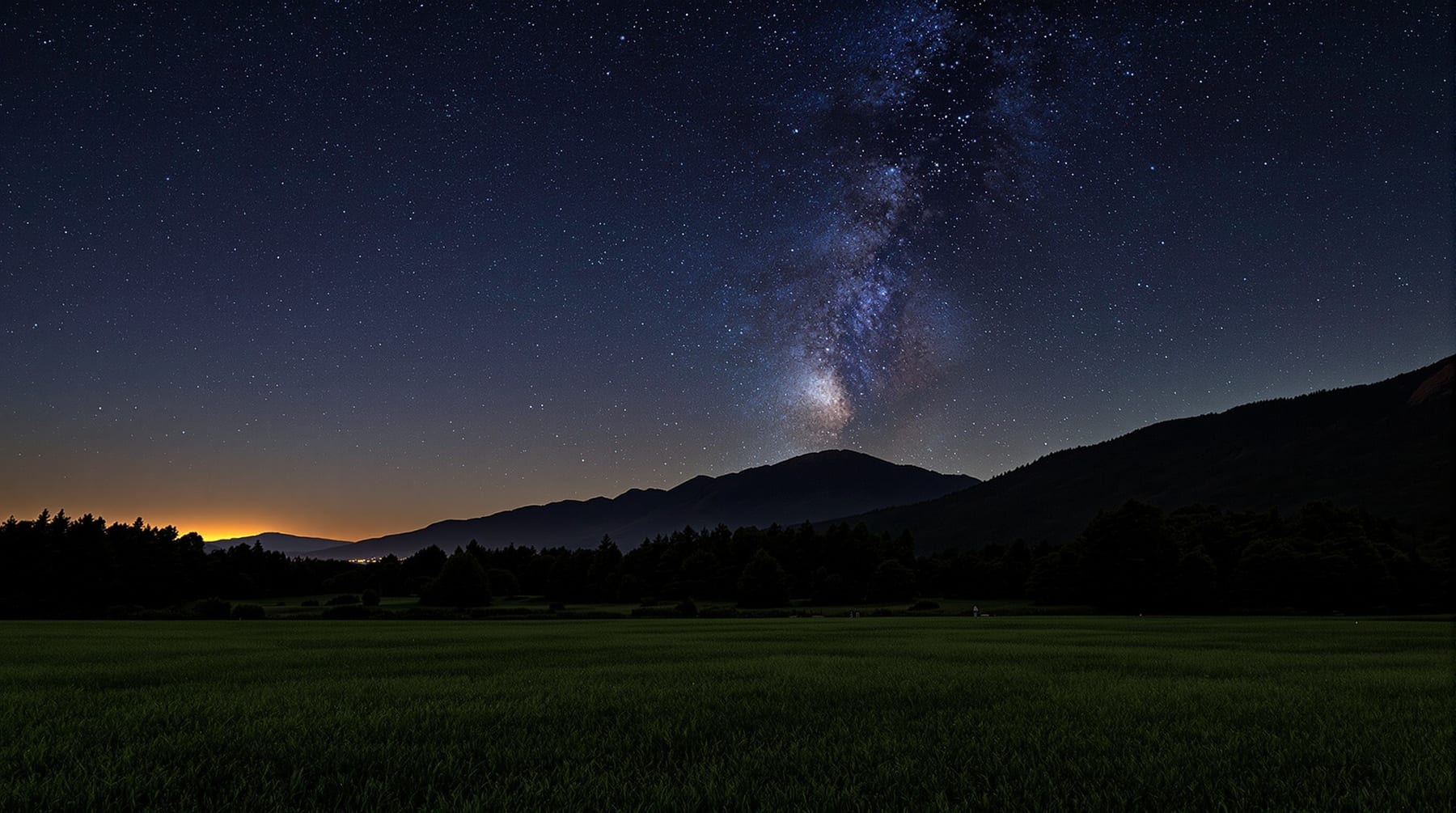
McDonald Park is a municipal park in Abbotsford, British Columbia, about ten to twelve minutes east of the city centre and roughly midway between Abbotsford and Chilliwack. On a map it looks unremarkable: a small patch of green off No. 3 Road, close enough to Highway 1 that you can hear it on a still night. On a clear moonless evening it is one of the best places to look at the sky anywhere within reach of a city of two and a half million people, and the reason is the mountain standing over it.
Why the site works
Sumas Mountain rises abruptly out of the valley floor immediately to the east. The park sits tucked against its flank, and the effect is very like standing at the base of an amphitheatre: the ground rises behind you and the sky opens in front. That geometry does three useful things at once.
- It screens Abbotsford. The city's light dome is to the west, and the local terrain and treeline take a substantial bite out of it at low elevations — the part of the sky where skyglow does the most damage.
- It screens Chilliwack. The mountain bulk itself blocks the eastern glow almost completely.
- It screens Mission. The northern approach is similarly cut off.
What is left is a broad, low, dark exposure running east through south to west, over farmland rather than over houses. That is close to ideal, because it is the arc in which everything interesting culminates. The ecliptic runs through it, so every planet crosses it. The summer Milky Way runs up out of it. And with the worst of the local glow behind you rather than in front of you, the contrast improvement is immediately obvious to the naked eye: the Milky Way at McDonald Park stands out as a genuinely structured band with the Cygnus rift visible as a dark lane, which it emphatically does not do from a suburban back garden ten kilometres away.
What the sky actually looks like there
It is worth being honest about the limits. This is not a wilderness site. On the Bortle scale it behaves like a class 4 sky on a good night — a rural/suburban transition sky — rather than the class 2 or 3 you would find on the Chilcotin plateau or in the Kootenays. Light domes are visible above several horizons. The southern horizon carries the combined glow of the border communities in Washington State, and on humid nights that glow spreads a long way up.
Within those limits it performs well. Naked-eye limiting magnitude on a good transparent night runs to around magnitude 6, sometimes a little better once you are properly dark-adapted. The Andromeda Galaxy is an easy naked-eye smudge in autumn. The Double Cluster in Perseus resolves in binoculars into two distinct grainy knots. The North America Nebula in Cygnus is detectable with a wide-field instrument and a nebula filter. In a moderate telescope the brighter Messier objects are not merely detectable but genuinely rewarding, with structure rather than just presence.
What the site cannot give you is the deep southern sky. At this latitude the galactic centre in Sagittarius culminates only about twelve degrees up, and from the valley floor that means looking through both a great deal of atmosphere and the brightest part of the local horizon glow. The globular clusters and nebulae of the Sagittarius region are visible from McDonald Park, but they are visible the way a distant mountain is visible through haze. That is a latitude problem, not a site problem, and no amount of local lighting reform will fix it.
The lighting story, as public record
A dark site near a growing city does not stay dark on its own. What makes McDonald Park unusual is that a series of documented municipal and utility decisions actively improved it rather than eroding it. The record includes several distinct changes.
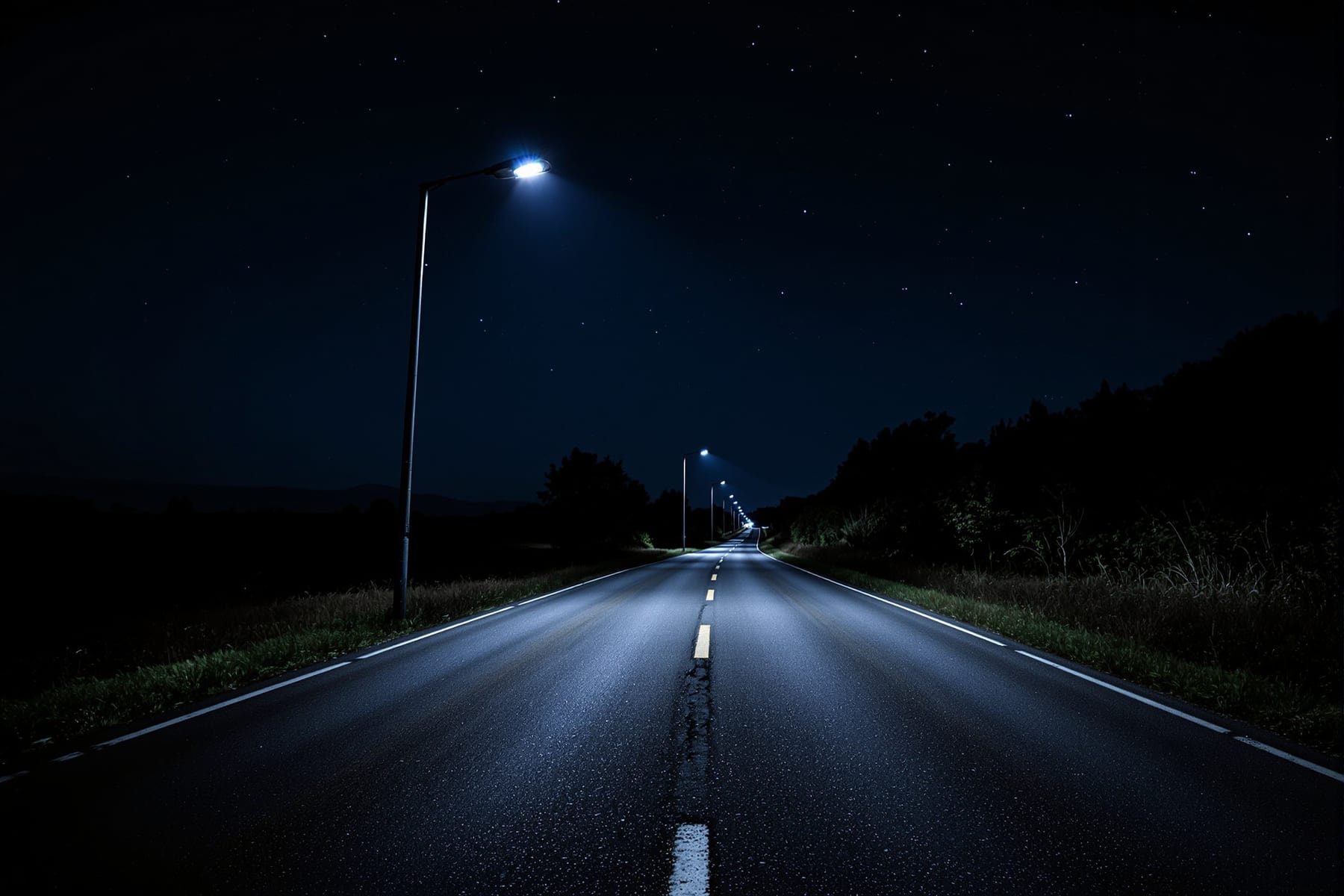
- Street lights converted to full-cutoff optics. Lighting on the roads near the park was refitted with fixtures that emit no light above the horizontal. A full-cutoff fixture puts its output onto the surface it is meant to illuminate, so from a few hundred metres away it is effectively invisible as a light source — you see the lit road, not the lamp. The practical result at the park is that the nearby street lighting casts no glare into the observing area at all.
- Highway interchange lighting reduced. Several lights were removed from the nearby Highway 1 interchange after a review found the area was substantially over-lit. Reducing the number of fixtures did not reduce the safety of the interchange; over-lighting produces glare and deep shadow contrast, and removing surplus fixtures can improve visibility rather than degrade it.
- A neighbouring agricultural property changed its yard light. A single unshielded rural yard light can ruin a site for everyone within a kilometre. One nearby farm converted to a full-cutoff fixture voluntarily — which is a reminder that the most effective lighting reform is often a conversation rather than a bylaw.
None of this required anyone to turn lights off. Every change kept the same tasks lit, and in some cases lit them better. That is the central and frequently misunderstood point about dark-sky work: it is a fixture and aiming problem, not an argument about whether people should be able to see at night. The longer account of how the valley got its dark-sky park sets these decisions in order.
Practical notes for a visit
McDonald Park is a City of Abbotsford municipal park, and Abbotsford's parks are day-use facilities. Access arrangements after dark are not something a guide like this can state as fact, because they change and because they have historically involved specific arrangements rather than a blanket rule. Check the current position with the City of Abbotsford's parks information before planning a night there, and treat any after-dark presence as conditional rather than assumed.
Assuming you are there legitimately, the site's practical characteristics are these:
- The ground is flat and open over the main field, which makes it straightforward to set up a tripod or a Dobsonian without hunting for level ground in the dark.
- Fresh water and washroom facilities exist on site. Whether they are available at any given hour is a different question — plan as though they are not.
- Dew is the dominant nuisance. The valley floor is agricultural, low-lying and close to the Fraser River, and on a clear calm night the temperature drops fast and everything gets wet. A dew shield on the telescope, a heater strip on the corrector or the eyepiece, and a cover for anything you are not using are not optional refinements here — they are the difference between three hours of observing and forty minutes.
- Traffic noise from Highway 1 carries. It bothers some people and not others. It has no effect on the view.
- Take everything out with you. Sites like this survive on the goodwill of the people who manage them, and a single bad night of litter or noise costs everyone.
Etiquette after dark
Dark adaptation takes twenty to thirty minutes to build and about a second to destroy. If other people are observing, a white light — a phone screen, a car interior light, a head torch on its bright setting — resets everyone's night vision at once. The conventions are simple and universal: red light only, dimmed as far as it will go; headlights off before you turn in; reverse into your spot when you arrive so you are not sweeping the field with your beam when you leave; and if you must use a phone, turn the brightness to minimum and shield it against your body.
If you are new to a dark site the other convention worth knowing is that amateur astronomers are almost uniformly happy to show you what is in their eyepiece and almost uniformly unhappy about being asked to move their telescope. Ask before you touch anything.
Getting there
Directions, parking and the orientation of the observing field are covered separately on the getting to McDonald Park page. For a comparison with the other dark-sky sites within driving distance of the valley — Chilliwack Lake, the Manning Park corridor, and the high plateau country behind Merritt — see observing sites in the Fraser Valley and southern interior.
For the broader question of what a dark-sky designation actually protects, and how the Canadian precedent for this kind of site was established, see dark-sky preserves in Canada. Comparable protective frameworks exist elsewhere; the United States National Park Service's night skies programme is a good example of how a large land manager approaches the same problem.