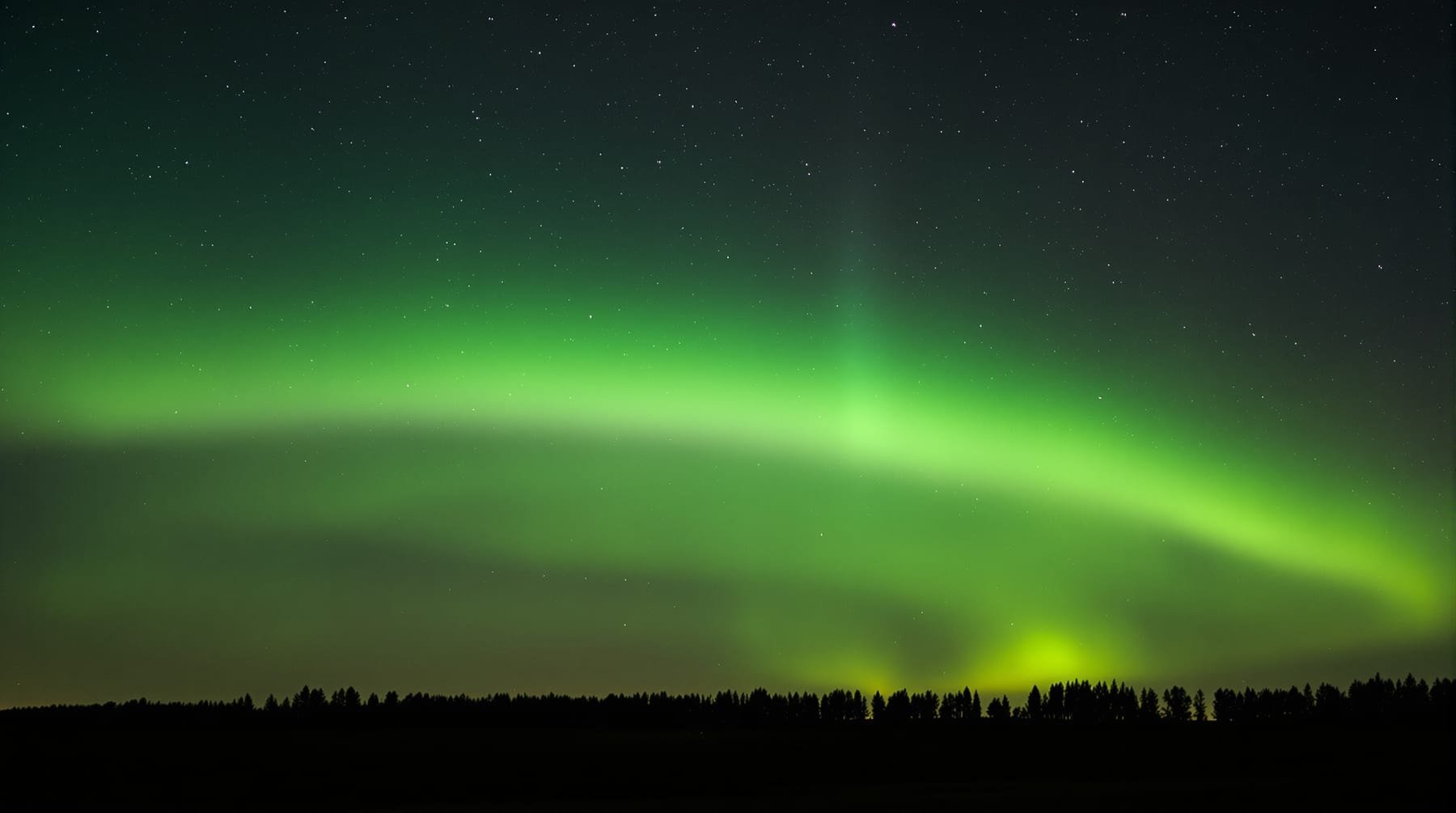
The Fraser Valley sits at an awkward and interesting aurora latitude. It is far enough north that displays reach it several times a year, and in an active part of the solar cycle rather more often than that. It is also far enough south that most of what arrives sits low on the northern horizon rather than overhead — which means the difference between a memorable night and a wasted one usually comes down to whether you understood the forecast and whether you had a clean sightline north.
What you are actually looking at
Aurora is atmospheric emission, not reflected light. Charged particles from the Sun, funnelled and accelerated along the Earth's magnetic field, collide with atoms and molecules in the upper atmosphere and excite them; the excited atoms then shed that energy as light at very specific wavelengths.
- Green, at 557.7 nanometres, comes from atomic oxygen at roughly 100 to 150 kilometres altitude. It is by far the most common colour and the brightest, and it is what most displays consist of.
- Deep red, at 630.0 nanometres, also comes from atomic oxygen but from much higher up, above about 200 kilometres. Because the emitting layer is so high, red aurora is visible from much further south than green — which is why a mid-latitude observer sometimes sees a red glow with no green below it. The green curtain is there; it is simply below the horizon.
- Blue and violet, around 428 nanometres, come from ionised molecular nitrogen, and generally appear only in strong displays and along the lower edges of active curtains.
That altitude difference is the single most useful fact for a valley observer. Because the emission happens 100 to 400 kilometres up, an aurora sitting over northern British Columbia is geometrically visible from here, low in the north, in exactly the way a very tall mountain would be. You are looking at something a long way away, over the horizon.
How much activity you need at this latitude
Geomagnetic activity is usually quoted as the Kp index, a scale from 0 to 9 derived from magnetometer readings worldwide. Kp is a blunt instrument — it is a three-hour average, it is planetary rather than local, and it tells you nothing about whether the display will be structured or a formless glow — but it is the number everyone uses, so it is worth calibrating against your own location.
The Fraser Valley's geomagnetic latitude is meaningfully higher than its geographic 49 degrees, because the magnetic pole sits over northern Canada. In practical terms, for an observer in the valley with a clear northern horizon:
- Kp 4 and below: essentially nothing, unless you are already well north of the valley and looking at a very clean horizon.
- Kp 5: a faint greenish or grey arc may be detectable low in the north from a dark site. Frequently invisible to the naked eye but obvious in a thirty-second camera exposure.
- Kp 6: the realistic threshold for a display worth driving for. Structure, movement and colour become visible, still concentrated in the northern third of the sky.
- Kp 7 and above: genuinely good from here. Rays and curtains reaching well up the northern sky, sometimes overhead in the strongest events, and colour visible to the unaided eye rather than only to a sensor.
Treat these as rough calibration rather than a rule. A Kp 5 event with a strongly southward interplanetary magnetic field can outperform a Kp 6 without one, and the substorm structure matters as much as the index. If you want the underlying physics rather than the index, the parameter to watch is Bz — the north-south component of the interplanetary magnetic field. When Bz turns firmly negative, the solar wind couples efficiently into the magnetosphere and things happen; when it is positive, high Kp forecasts routinely disappoint.
Forecasts worth watching
Two official sources are worth having bookmarked, and they complement each other.
- The NOAA Space Weather Prediction Center at spaceweather.gov publishes the three-day Kp forecast, real-time solar wind measurements from the L1 satellites including Bz, and the short-term auroral oval model. The solar wind data is the closest thing to a genuine short-notice warning: the L1 point is about an hour upstream, so a sudden southward Bz turn gives you roughly that much notice.
- Natural Resources Canada runs a Canadian space weather service at spaceweather.gc.ca with forecasts oriented to Canadian latitudes and a network of domestic magnetometers, which makes its local-activity picture more directly relevant here than a planetary index.
Solar activity follows a roughly eleven-year cycle, and aurora frequency at mid latitudes tracks it closely. Near solar maximum a valley observer might reasonably expect several worthwhile displays a year; near minimum, one or none. NASA's solar science pages track where the current cycle stands.
Where to stand
The requirement is unusual for astronomy: you want a low, open northern horizon and you are comparatively relaxed about overall sky darkness, because a decent display outshines moderate skyglow. That inverts the usual site logic.
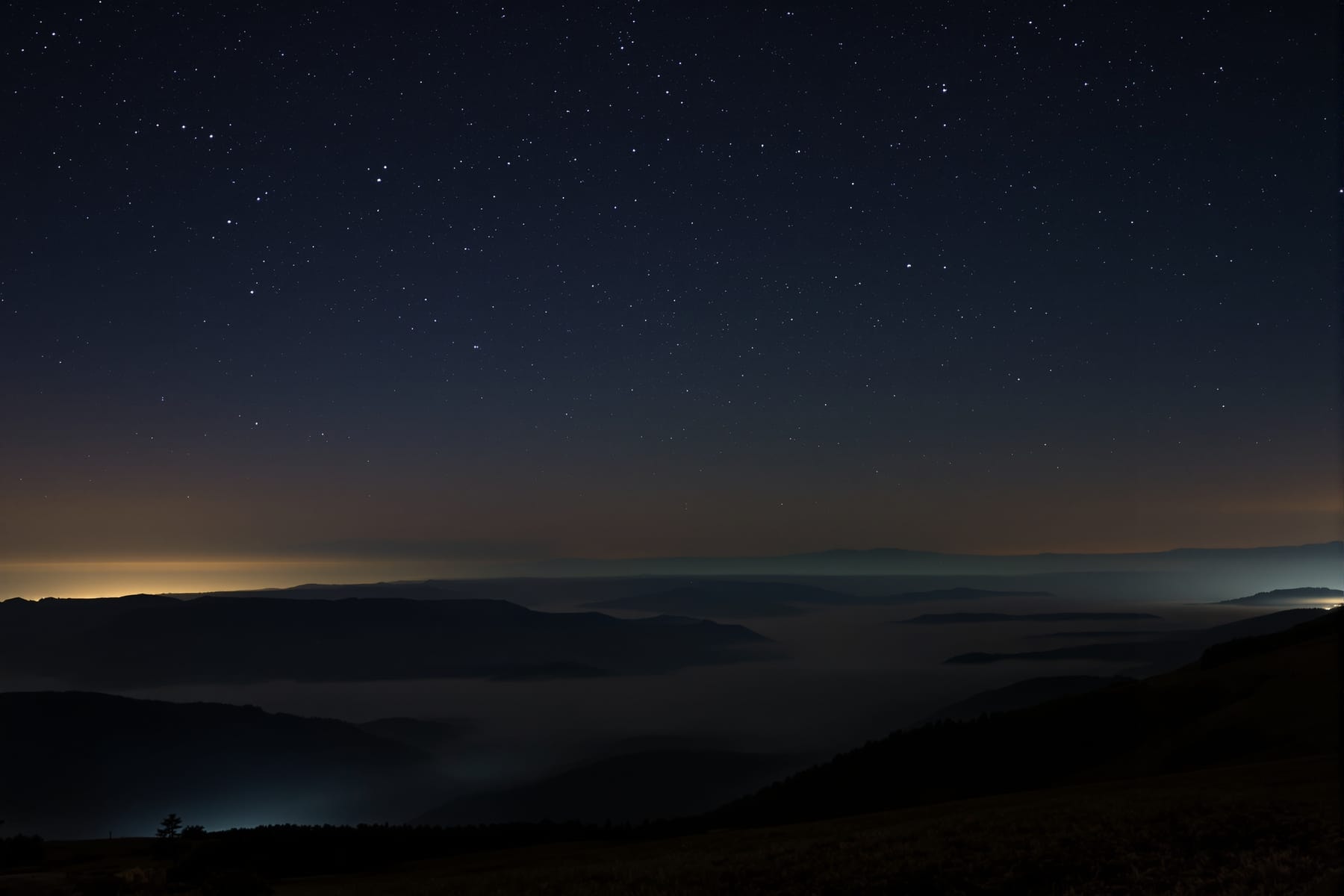
The valley's protected dark-sky site is, ironically, one of the weaker choices for aurora, because the mountain and treeline that make it good for deep-sky work sit in the wrong direction. Better options are anywhere with an unobstructed view north across open ground or water — the higher farmland benches, the north-facing shorelines, and the logging-road viewpoints that gain elevation on the valley's northern side. Elevation helps twice over: it clears the terrain and it gets you above the low-level haze and inversion layers that the valley floor collects on calm nights.
The other consideration is the Metro Vancouver light dome to the west. It rarely lands directly on a northern display but it raises the general background, and driving east up the valley to put more distance between you and it is usually worth the fuel. See observing sites in the Fraser Valley and southern interior for the general options.
Why it looks grey to the eye and green in the photo
This surprises almost everyone the first time. A display that photographs as a vivid green curtain frequently appears to the naked eye as a pale grey or faintly greenish glow, easily mistaken for high cloud.
The reason is the structure of human vision. Colour perception depends on the cone cells in the retina, which need a reasonable light level to respond. Below that threshold you are seeing with rod cells, which are far more sensitive but effectively colour-blind. Most mid-latitude aurora sits right around the transition, so you see shape, movement and brightness but very little hue. A camera has no such threshold: a twenty-second exposure at a moderately high ISO accumulates enough photons to record the 557.7-nanometre emission at full saturation.
Two practical consequences. First, use the camera as a detector. If you suspect there is something low in the north, take a fifteen-second test exposure at a high ISO; it will settle the question far more reliably than your eyes will. Second, be honest about what you photograph. A heavily saturated aurora image does not represent what a bystander would have seen, and there is a difference between recording faint emission accurately and manufacturing it in post-processing.
For exposure settings, lens choice and the mechanics of shooting on a cold damp valley night, see astrophotography in the Fraser Valley.